Reiki, "Energy Healing," and Religious Worry
A Reiki teacher's honest read of a 2026 Salt Lake Tribune commentary on "energy healing," "frequency" language, and religious concern.

Japanese Reiki Shihan (師範) · traditional Usui Reiki · 20+ years of daily practice
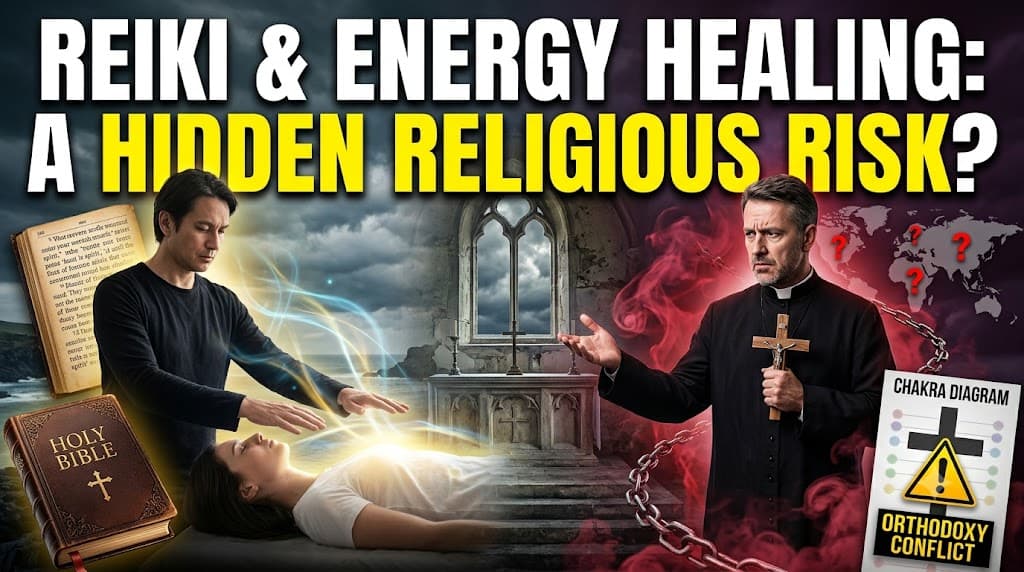
"Energy Healing," "Frequency," and Religious Worry: A Reiki Teacher's Honest Read of a 2026 Commentary
A grounded look at a 2026 commentary on "energy healing" fears — and where Reiki actually fits.
The source is an April 2026 opinion column in The Salt Lake Tribune by Matthew Bowman, arguing that the spread of "energy healing" and the vocabulary of "frequency" is beginning to worry some religious leaders — including in the Church of Jesus Christ of Latter-day Saints (LDS). It opens with a personal, grief-touched anecdote from Erika Kirk and uses a single word — frequency — as a doorway into a broader cultural observation. It is a commentary, not a study, and most of the piece sits behind a paywall, so what can be responsibly summarised here is only the visible opening. For anyone curious about Reiki, it is a useful window into how "energy" talk is perceived from the outside — even though the article never names Reiki in the portion we can actually read.
Part 1: What the Source Says
Key Points
| Detail | What the visible source says |
|---|---|
| Type | Opinion commentary column — not a study, survey, or measurement |
| Outlet | The Salt Lake Tribune |
| Author | Matthew Bowman (Special to The Tribune) |
| Date | April 3, 2026 (published 4:00 a.m., updated 10:32 p.m.) |
| Central theme | The growth of "energy healing" and "frequency" language worries some LDS, Catholic, and other religious leaders |
| Opening anecdote | Erika Kirk, widow of Charlie Kirk, recounted his apparent effect on flickering light bulbs, and a hotel-room light that dimmed then brightened the night after his death — which she called "a total frequency thing" |
| Author's observation | "Frequency" does not appear in the New Testament or traditional Christian liturgy, yet has a long history in American religion and is increasingly used by people who identify as Christian |
| Noted concern | Some LDS practitioners are said to view energy healing as a source of spiritual authority for women who cannot be ordained to priesthood office |
| Reiki specifically | Not named in the visible portion; the piece speaks of "energy healing" broadly (the accompanying image shows a crystal-healing card deck for sale in Salt Lake City) |
| Access | The full article is paywalled / archived for donors, so only the opening is available |
The Salt Lake Tribune — "Commentary: Growth of 'energy healing' worries LDS, Catholic and other religious leaders" (April 3, 2026) This summary was written from publicly available facts for explanatory purposes; see the original at the link above.
Part 2: What It Does — and Doesn't — Show
It's a commentary, not a measurement
The first thing to be clear about is the kind of writing this is. It is a signed opinion column — one author making an argument — not a survey, a poll, or a piece of research. There are no figures on how many people practise "energy healing," no trend data, and no attempt to test whether any of it "works." So the honest reading is that this tells us about a perception and a concern, not about prevalence or efficacy. Treating a columnist's observation as proof that energy practices are surging (or as proof that they are harmless) would be reading in more than the text supports.
"Energy healing" is a very wide umbrella
The article uses "energy healing" as a broad category, and the illustration points to crystal card decks rather than to any single method. Reiki — 靈氣 (Reiki), roughly "spiritual" or "universal life energy" — is one practice that often gets filed under that umbrella, but it is not the same as crystals, "frequency" work, or the light-bulb anecdote at the top of the piece. In the portion we can read, Reiki is never mentioned by name. It would be a mistake to assume the commentary is describing traditional Japanese Usui Reiki specifically; it may or may not, and we simply cannot tell from the visible text.
The anecdote is personal, not evidence
The Erika Kirk story is a moving, grief-shaped account — a widow finding comfort in a flickering light. That is a human experience, and it deserves to be treated gently. But it is not evidence of anything physical, and the article does not present it as such. It functions as a hook: a way to introduce the word frequency and the cultural question the author actually wants to raise. Keeping the emotional anecdote and any factual claim clearly separated is part of reading this piece honestly.
The worry is theological, not medical
The concern the article describes is about religion and spiritual authority — leaders uneasy that "frequency" language is drifting into Christian speech, and that some practitioners treat energy work as a form of authority. That is a legitimate cultural and pastoral question. It is not a claim about safety, illness, or treatment, and this explainer makes no such claims either.
What we simply can't see
Because most of the column is paywalled, the fuller argument — its examples, its nuances, whatever balance the author strikes later — is not available to us. So a careful summary has to stop where the visible text stops. Anyone wanting the complete case Bowman makes should read the original in full.
Part 3: A Grounded Practitioner's Take
Reading this as a traditional Usui teacher, my first reaction is recognition, not defensiveness. The unease the article describes is real, and I think a lot of it comes from language. Words like frequency carry a certain glow — they sound scientific and mystical at the same time — and when that vocabulary starts appearing everywhere, it is natural for thoughtful religious leaders to ask what it means and where it fits.
Here is the honest part: in the Japanese Usui stream I was taught, we do not lean on "frequency" talk at all. The heart of the tradition is quieter than that — a short daily practice, relaxation, and the five precepts (五戒, Gokai): just for today, do not anger, do not worry, be grateful, work diligently, be kind to others. That is closer to an ethic for the day than to a cosmology, and it competes with no one's faith.
I also came in from an unglamorous angle, which shapes how I read pieces like this. I didn't arrive at Reiki through the spiritual world. The person who first told me about it was someone already successful in business — getting real results in the ordinary world, not a "spiritual" type at all. That mattered to me: my very first impression of Reiki had nothing to do with the mystical image most people expect. So when an article treats "energy healing" as one undifferentiated, slightly worrying cloud, I understand the reflex, but I also know the ground-level experience can be far more mundane — twenty minutes of settling, a bit of relaxation, a habit of gratitude.
On the question the article circles without stating — does any of this actually do something? — I try to stay where the evidence is. Bodies like the U.S. National Center for Complementary and Integrative Health (NCCIH) describe the research on Reiki as limited and inconclusive, and I have no interest in overstating it. What people most often report is feeling relaxed, settled, a little lighter. That is the honest claim. It is not medical care, not diagnosis, not treatment, and not a cure, and I would never present it that way. If someone's beliefs make energy language uncomfortable, that is worth respecting rather than arguing away — there is a right time for everything, and no one needs to be pushed.
FAQ
Q: Does this article say Reiki is fake or harmful? A: No. In the portion available to read, it doesn't evaluate whether energy practices "work," and it doesn't name Reiki at all. It describes a cultural and religious concern about the spread of "energy healing" and "frequency" language — a different thing from a safety or efficacy verdict.
Q: Is Reiki a religion, and would it conflict with my faith? A: Traditional Usui Reiki is a practice of relaxation and self-care paired with a short set of ethical precepts; it isn't a religion and has no doctrine to sign up to. People of many faiths — and of none — practise it. Whether it sits comfortably with your own beliefs is a personal question, and a fair one to ask, exactly as the article's subjects are asking it.
Q: What does "frequency" mean in Reiki? A: In the traditional Japanese line I was taught, we don't really use "frequency" language — that vocabulary comes more from broader energy-healing and new-age culture than from Usui practice. The emphasis is on relaxation and the five precepts, not on tuning into a frequency.
Q: Can energy healing cure illness? A: No. Reiki is not medical care, diagnosis, or treatment, and no claim of curing anything is being made here. What people commonly describe is feeling calmer or lighter. For any health concern, please see a licensed professional.
Sources
About the author
Japanese Reiki Shihan · traditional Usui Reiki, taught and certified in person
- ●Japanese Reiki Shihan (師範 / Reiki Master)
- ●Trained in the traditional Japanese Usui lineage
- ●20+ years of daily practice · teaches in person
- ●Former IT engineer & founder — grounded, no hype
I'm a Japanese Reiki Shihan who learned in the traditional Usui lineage and has practised every morning for over twenty years. My background is in IT and business, not the spiritual scene, so I write about Reiki plainly — what it is, how to practise it, and what it's honestly like — with no medical claims. Based in the Philippines, where I teach in person.
Enjoy this article?
Get honest, grounded writing on traditional Japanese Usui Reiki straight to your inbox.
Related Articles

Self-Reiki for Sleep: What "Reiki Lite" Shows
A grounded look at "self-Reiki" for sleep from a Bustle wellness piece: what the calming hands-on ritual genuinely offers, and what it doesn't.
7/3/2026
Does Reiki Actually Work? A Grounded Reading
A Reiki Master's honest look at a Verywell Mind explainer: what the small studies on relaxation and blood pressure show, and what they don't.
7/1/2026
10-Minute Reiki Study: What the Chicago Data Shows
A 2025 Chicago study tested 10-minute Reiki on 1,700+ people. See what the stress and pain data really shows — and what it can't prove.
7/1/2026