Reiki in the Hospital: What BMC's Story Really Shows
A Boston hospital folds Reiki into bedside care and reports high patient satisfaction. Here's what those figures honestly show — and what they don't.

Japanese Reiki Shihan (師範) · traditional Usui Reiki · 20+ years of daily practice
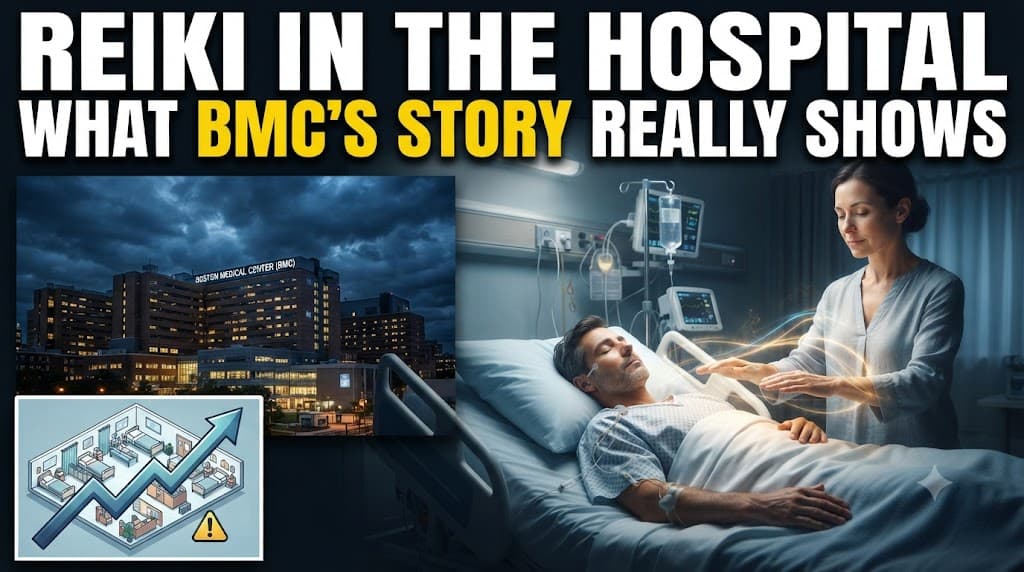
A grounded look at how one U.S. hospital uses Reiki at the bedside — and what its numbers can and can't prove.
This explainer looks at a March 2025 HealthCity article from Boston Medical Center (BMC) describing how its nurses fold Reiki, aromatherapy, and mindfulness into bedside care. The piece reports program milestones, a 2024 holistic-nursing award, and strongly positive patient-satisfaction numbers. For anyone curious about Reiki, it's a useful window into how a large U.S. teaching hospital treats it — as a relaxation-focused complement offered alongside medical care, not as a replacement for it. It is a news feature, though, not a clinical trial, and as of its publication date (March 20, 2025) that distinction shapes how much we can read into the figures.
Part 1: What the Source Says
BMC's article describes an "integrative nursing" model in which bedside nurses offer non-drug, mind-body approaches — Reiki among them — to complement standard treatment. It frames this as an institution-wide program with training, record-keeping, research, and an award behind it.
Key Points
| Item | What the article reports |
|---|---|
| Award | In 2024, the American Holistic Nurses Association gave BMC the Institutional Excellence in Holistic Nursing Practice Award |
| Origins | Began as a grassroots Reiki practice among a small group of nurses more than two decades ago; the Integrative Nursing Council dates its formal work from 2016 |
| Reach | 200+ care practitioners trained; 6,000+ patients treated with integrative therapies |
| Patient survey | Of 144 patients surveyed, 100% said the therapies aided their healing; 98% said they would want to repeat treatment if hospitalized again |
| Daily demand | An integrative nurse typically fields 20–40 requests per day |
| Therapies logged | Reiki, aromatherapy, meditation/mindfulness, palliative-care education, art therapy, pet therapy, and music — now enterable as patient requests in the EPIC medical record |
| Aromatherapy use | Operating-room nurses use scents such as ginger, peppermint, and red mandarin to help patients manage post-operative nausea |
| Nurse self-care study | A three-month project offered "intentional grounding" to 31 ICU nurses; surveys reported lower or better-managed stress |
| Fellowship | An Integrative Nursing Fellowship was established in 2022, allotting 12 hours per week of dedicated time |
| Institutional context | The Joint Commission encourages hospitals to offer integrative therapies for pain, partly to reduce reliance on opioids |
HealthCity (Boston Medical Center) — "From Reiki to Aromatherapy: Inside BMC's Award-Winning Integrative Nursing Model" (March 20, 2025) This summary was written from publicly available facts for explanatory purposes; see the original at the link above.
Related: How Distant Reiki Works — and Why I Never Send It Uninvited explains this in detail.
Part 2: What It Does — and Doesn't — Show
First, some plain definitions. Reiki — 霊気 (Reiki) / "universal life energy" — is a Japanese practice in which a practitioner holds gentle or no-touch hand positions with the aim of helping a person relax and settle. Integrative medicine here means pairing conventional medical treatment with complementary, non-drug approaches. Intentional grounding is the self-care technique the article says was studied among nurses.
What this source is: a well-reported feature about how one hospital adopted, organized, and expanded a non-drug care program. On that, it's informative and credible. The institutional context is real — professional bodies do encourage non-pharmacological options for pain, and the American Nurses Association formally recognized holistic nursing back in 2006. Logging patient requests in a medical record and training hundreds of nurses are genuine signs of a serious, structured program.
What this source is not: evidence that Reiki produces a specific effect beyond relaxation. Nothing here is a controlled efficacy trial, and it's worth being precise about why the headline numbers can't carry that weight.
The patient survey (144 people; 100% and 98%) measures satisfaction, not effectiveness. Those surveyed had asked for and received the therapies, and were asked afterward how they felt — a setup that invites uniformly positive answers (what researchers call selection and demand effects). There is no comparison group, no blinding, and no way to separate Reiki from the aromatherapy, music, and simple caring attention delivered alongside it. High satisfaction is a real and worthwhile finding; it just isn't the same as proof that Reiki did something a comparable moment of quiet rest would not.
The opening anecdote — a patient who fell asleep and whose headache reportedly eased — is a single, uncontrolled story. Rest, hydration, medication, a darkened room, calm attention, and the natural course of a headache can each account for it. One person's experience, however moving, cannot establish cause.
The nurse "intentional grounding" project has the same limits: 31 participants, self-selected, no control group, self-reported outcomes over three months. It suggests the nurses felt better; it can't show that grounding specifically caused the change rather than time, attention, or expectation.
None of this is a knock on the program. It's simply the honest ceiling of what a news feature can demonstrate. For Reiki in particular, independent scientific bodies such as the U.S. National Center for Complementary and Integrative Health (NCCIH) describe the evidence for effects beyond relaxation and placebo as limited and inconclusive. This article doesn't change that picture — and, to its credit, it mostly speaks in the honest language of comfort, sleep, and stress rather than cure.
Related: An Engineer's Honest Take on Reiki: What I Am Willing to Claim, and What I Am Not explains this in detail.
Part 3: A Grounded Practitioner's Take
What I notice first, reading this as a traditional Usui-lineage teacher, is how modest the honest claims are: patients rested, slept, felt settled; nurses managed stress a little better. That is exactly the register I would use. Reiki is not medicine, not diagnosis, not a cure — it is a way of helping a person arrive at rest. A hospital that offers it as one calming option among many, and that keeps its language to relaxation rather than treatment, is reading it the same grounded way I try to.
The bedside picture in this article lines up with something long practice has taught me: the short session is not a compromised version of the long one. So when a brief bedside session leaves someone able to finally sleep, I don't find it mysterious — a person allowed to stop, breathe, and let go will often settle quickly. Whether you name that Reiki, presence, or plain rest, the settling is what's real, and it's enough on its own terms without any medical claim attached.
The daily side of the tradition — keeping Usui's Five Precepts, 五戒 (Gokai) close, practising a little each morning — points the same direction: small, repeatable, undramatic. I'd gently caution against reading survey percentages as evidence that Reiki "works" in a clinical sense; they show that people who chose it felt cared for, which is worth something but is not the same thing. Held to that honest standard, this is a heartening story about comfort at the bedside, and I'd leave it there.
FAQ
Q: Does this article prove Reiki works? A: No. It's a news feature about a hospital program and about how satisfied patients felt — not a controlled study. It can show adoption and satisfaction; it can't establish that Reiki produces a specific effect beyond relaxation.
Q: A patient's headache "all but resolved" after Reiki — wasn't that the Reiki? A: A single story can't prove cause. Rest, sleep, medication, hydration, and simply the natural course of a headache could each explain it. In grounded terms, Reiki here is about helping someone relax, not treating a symptom.
Q: Is Reiki medical care? A: No. In this program it's offered alongside conventional treatment as a way to help patients relax and feel settled. It is not diagnosis, treatment, or a cure, and it shouldn't replace medical care.
Q: What does "integrative" mean in a hospital like this? A: It means combining standard medical treatment with complementary, non-drug approaches — things like aromatherapy, mindfulness, music, and Reiki — chosen to support comfort and wellbeing.
The Bottom Line
- The source is a March 2025 BMC news feature reporting an award-winning integrative nursing program, thousands of patients treated, and very high patient-satisfaction figures.
- Those figures measure satisfaction and program adoption — not effectiveness; with no control group, no blinding, and Reiki bundled with other therapies, the article can't show Reiki produces a specific effect beyond relaxation.
- The single-patient anecdote and the 31-nurse self-care project are encouraging but uncontrolled, and can't establish cause.
- A grounded practitioner reads it the way the hospital mostly frames it: as comfort, rest, and stress relief — real and worthwhile, with no medical claim attached.
Read honestly, it's a warm account of bedside comfort, not proof of anything more.
Sources
About the author
Japanese Reiki Shihan · traditional Usui Reiki, taught and certified in person
- ●Japanese Reiki Shihan (師範 / Reiki Master)
- ●Trained in the traditional Japanese Usui lineage
- ●20+ years of daily practice · teaches in person
- ●Former IT engineer & founder — grounded, no hype
I'm a Japanese Reiki Shihan who learned in the traditional Usui lineage and has practised every morning for over twenty years. My background is in IT and business, not the spiritual scene, so I write about Reiki plainly — what it is, how to practise it, and what it's honestly like — with no medical claims. Based in the Philippines, where I teach in person.
Enjoy this article?
Get honest, grounded writing on traditional Japanese Usui Reiki straight to your inbox.
Related Articles
A Reiki Trial That Finally Included a Sham Group
A 2026 trial compared Reiki against sham Reiki in 60 ventilated ICU patients. An honest reading of what the results support.
8/18/2026

Why Most Reiki Studies Cannot Be Compared With Each Other
People ask what the research says as though the studies can be added together. Four ordinary differences block comparison.
8/17/2026

What the Reiki Trials Now Running Will and Will Not Settle
Fourteen Reiki trials are registered as recruiting or active. Twelve enrol under 100 people and four have no blinding.
8/16/2026

The Page I Send People To Says Reiki Does Not Work
A federal health agency says Reiki has not been shown effective. A practitioner explains why he quotes it in full.
8/15/2026
Ten Nurses, Five Sessions, No Control Group
A 2025 Brazilian study interviewed ten nurses after five Reiki sessions. Reading it honestly means knowing what it cannot show.
8/14/2026

Ten Years of Hospital Reiki, and the Sentence Buried
A cancer institute's ten-year Reiki programme and an 824-person anxiety meta-analysis say different things, and the honest reading sits in the gap between them.
8/13/2026