Reiki, Mindfulness & Knee Pain: A 2026 Study
A 2026 study reported Reiki and mindfulness eased knee osteoarthritis pain. Here's what it honestly shows, what it doesn't, and how a practitioner reads it.

Japanese Reiki Shihan (師範) · traditional Usui Reiki · 20+ years of daily practice
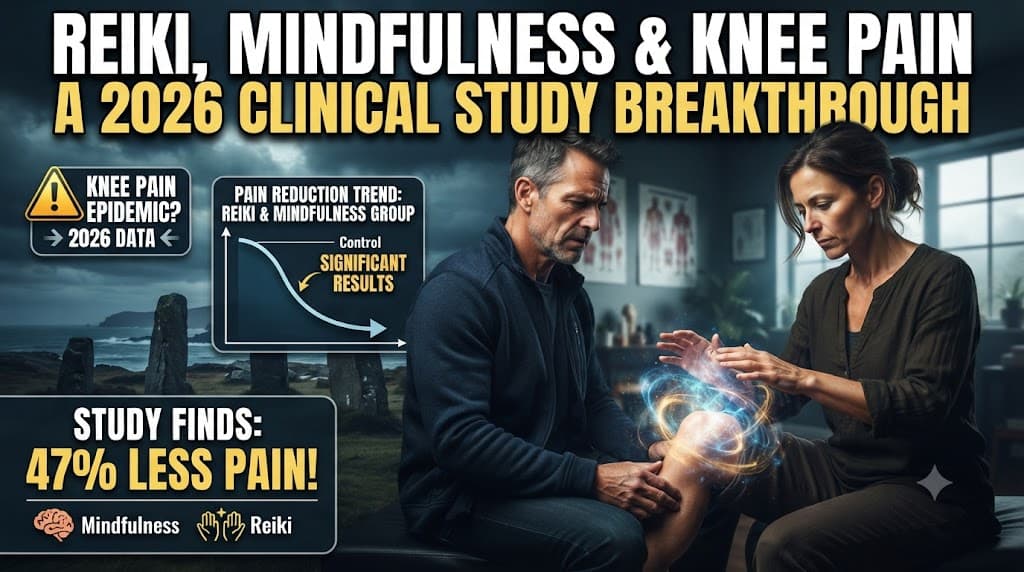
Reiki, Mindfulness, and Knee Pain: What the 2026 Study Report Does and Doesn't Show
A grounded look at what the 2026 Reiki and mindfulness knee-pain study really shows — and what it doesn't.
A March 2026 news article in Men's Journal reports on a study — published in the journal Complementary Therapies in Medicine — that looked at two non-drug approaches to knee osteoarthritis pain: Reiki and a mindfulness practice. The headline figure is a 32 percent reduction in pain, with mindfulness reportedly helping more than Reiki, and the researchers themselves calling for larger trials. For anyone curious about Reiki, it is worth reading carefully: the article is encouraging in tone, but a news write-up is not the same thing as the full study, and the interesting parts live in the details it leaves out. This piece walks through what the source actually says, what it can and cannot support, and how a grounded practitioner reads it.
Part 1: What the Source Says
Key Points
The article frames Reiki and mindfulness as "complementary" tools for chronic pain — additions to, not replacements for, ordinary care. Here is a plain summary of the concrete facts it reports.
| Item | What the source reports |
|---|---|
| Where it was published | The study appeared in the journal Complementary Therapies in Medicine |
| Institutions named | Researchers from Harvard, the University of Utah, and Florida State University |
| Lead researcher | Adam Hanley, PhD |
| Condition studied | Knee osteoarthritis pain |
| Approaches tested | Reiki and a mindfulness practice (which may include breathing techniques) |
| Headline result | A 32 percent reduction in pain |
| Comparison between the two | Mindfulness reportedly gave greater relief than Reiki |
| Follow-up timing | Participants were checked again at one month and two months |
| Safety note | Reiki was described as having minimal adverse events and strong patient engagement |
| Researchers' own caveat | Larger clinical trials are needed; these may be used in addition to, not instead of, traditional pain relief |
| Background figure cited | Chronic pain is said to affect more than 60 million adults in the US |
Men's Journal — "Scientists Discover a Surprising Way to Reduce Pain Without Medication" (Mar 6, 2026) This summary was written from publicly available facts for explanatory purposes; see the original at the link above.
Part 2: What It Does — and Doesn't — Show
Let's start with what the source genuinely supports. A peer-reviewed study, involving researchers affiliated with well-known institutions, reported that participants with knee osteoarthritis experienced measurable pain reduction after receiving either Reiki or a mindfulness practice — with a headline figure of 32 percent, and with follow-up at one and two months to check whether the effect lasted. That is a real, reported result, and the framing is admirably cautious: the researchers themselves say larger trials are needed and that these approaches should sit alongside conventional care, not replace it.
Now, what the news article does not give us — and this matters — is the methodology. A short trending-news piece is a secondary source. It does not report the sample size, so we cannot tell whether this was a handful of people or a large group. It does not describe whether there was a sham Reiki arm (a "pretend" version used to separate the specific effect from the general experience of lying down, being cared for, and relaxing). It does not mention blinding — whether participants or assessors knew which treatment they were getting. And the 32 percent figure is quoted without telling us which group it applies to, what it was measured against, or how much of that change might also appear in people who simply rested or expected to feel better.
These are not nitpicks; they are the whole game in this kind of research. The article itself gestures at the crux when it notes that, until now, evidence for whether Reiki "truly works" versus acting as a placebo effect has been scant. That honesty is welcome. It also quietly complicates the story: if mindfulness — a practice with its own well-studied relaxation effects — outperformed Reiki in the same trial, one reasonable reading is that both may be tapping shared pathways like relaxation, attention, and expectation, rather than something unique to Reiki alone. The study does not settle that question, and the reporting does not claim to.
A useful benchmark here is the careful language used by bodies like the US National Center for Complementary and Integrative Health (NCCIH), which has generally described the evidence for Reiki as limited and inconclusive. Nothing in this single report overturns that summary. What it offers is one more encouraging data point, plus the researchers' own call for bigger, better-controlled trials — exactly the honest posture the article ends on: "another tool in the toolbox," to be investigated further, not a proven cure.
One term worth defining, since the article uses it loosely: Reiki (霊気 / Reiki / "spiritual energy" or "universal life energy") is described in the source as originating in Japan in the 1920s and using light-touch or hands-off techniques. That origin detail is broadly right — the practice traces to Mikao Usui (臼井甕男) in that era. What the article cannot tell you, and does not try to, is why any relief occurs. It reports an outcome, not a mechanism.
Part 3: A Grounded Practitioner's Take
As someone who came to Reiki with an engineer's habit of asking "where's the evidence?", I read a study like this with genuine interest and a healthy pause. I like that the researchers refused to overclaim. I like even more that they built in follow-up at one and two months, because a real effect should show some staying power, not just a nice afternoon. And I take the "minimal adverse events" note seriously: whatever else is true, sitting quietly to receive Reiki is a gentle thing to do.
But I would never present a study like this as proof that Reiki "treats" a knee, and neither would I want a student to. Reiki, as I practise and teach it in the traditional Japanese Usui line, is not medical care. What it reliably offers, in my experience, is a settling — a way to feel lighter and calmer. And here is where this particular study actually rings true to me. The detail that mindfulness helped at least as much as Reiki, and that both are quiet, relaxation-based practices, matches something I say often to beginners.
A common misunderstanding is that the harder you concentrate, or the longer you sit, the more it works. In my experience it is the opposite. Relaxation matters most, and even a short session is enough — my own five honest minutes each morning are the proof. If a trial finds benefit from letting people slow down, breathe, and be gently attended to, that fits the grain of the practice rather than contradicting it. It also keeps me humble about mechanism: I don't need a study to tell me Reiki is worth doing, and a study also can't tell you it will do any specific thing for you.
So my take is neither cheerleading nor dismissal. It is: encouraging, incomplete, and pointed in the right direction. The precepts I keep each morning — just for today, do not anger, do not worry, be grateful, work diligently, be kind to others (五戒 / Gokai / the Five Precepts) — are about how to live, not about beating a diagnosis. I read this study the same way I hold those: as support for a calmer, steadier daily life, and nothing more grand than that.
FAQ
Q: Does this study prove Reiki relieves pain? A: No. It is one reported study, summarized in a news article that leaves out key methodological details like sample size and whether there was a sham control. The researchers themselves called for larger trials. It is an encouraging data point, not proof.
Q: Why did mindfulness reportedly help more than Reiki? A: The source doesn't explain why. One reasonable reading is that both practices share calming, attention, and expectation effects, and that this particular trial happened to see a larger effect in the mindfulness group. It's a question for future, better-controlled research, not a settled conclusion.
Q: Can I use Reiki instead of my regular treatment for knee pain? A: No. Even the article is explicit that these approaches are meant to be used in addition to, not instead of, ordinary care. Reiki is not medical treatment, and any pain or health concern belongs with a qualified healthcare professional.
Q: What can Reiki honestly offer, then? A: In plain terms, many people describe feeling relaxed, settled, and lighter during and after a session. That is the modest, honest ground I stand on — not curing, treating, or diagnosing anything.
The Bottom Line
- A March 2026 Men's Journal article reports a study in Complementary Therapies in Medicine finding pain reductions (a 32 percent figure) in people with knee osteoarthritis who received Reiki or a mindfulness practice, with mindfulness helping more.
- What it honestly shows is limited: the news write-up omits sample size, control/sham design, and blinding, and the researchers themselves say larger trials are needed and that these are complementary — not replacement — options.
- It does not, and cannot, prove Reiki treats or cures anything; the placebo-versus-effect question the article itself raises remains open, consistent with cautious summaries like the NCCIH's.
- A grounded practitioner reads it as encouraging but incomplete — a reminder that relaxation is the honest heart of the practice, worth doing for how it helps you feel settled, never as medical care.
Sources
About the author
Japanese Reiki Shihan · traditional Usui Reiki, taught and certified in person
- ●Japanese Reiki Shihan (師範 / Reiki Master)
- ●Trained in the traditional Japanese Usui lineage
- ●20+ years of daily practice · teaches in person
- ●Former IT engineer & founder — grounded, no hype
I'm a Japanese Reiki Shihan who learned in the traditional Usui lineage and has practised every morning for over twenty years. My background is in IT and business, not the spiritual scene, so I write about Reiki plainly — what it is, how to practise it, and what it's honestly like — with no medical claims. Based in the Philippines, where I teach in person.
Enjoy this article?
Get honest, grounded writing on traditional Japanese Usui Reiki straight to your inbox.
Related Articles

Reiki on a Fertility Wellness Menu: An Honest Read
A New York Post roundup lists Reiki among NYC fertility wellness options. What it honestly shows about Reiki, relaxation, and unproven claims.
7/17/2026
Lili Reinhart, Reiki Master: A Careful Reading
Lili Reinhart says she's a Reiki master. A Japanese Usui teacher reads the Marie Claire interview plainly: what it shows, what it doesn't, and why.
7/14/2026

Energy Healing Searches Hit a High — A Reiki Take
The AJC reports record "energy healing" searches in 2026. What that trend actually shows about Reiki — and what it plainly does not.
7/13/2026

Djokovic and Reiki: What the Headline Doesn't Show
The Indian Express tied Novak Djokovic to Reiki in its headline. A close look at what the piece actually shows — and what one athlete can't prove.
7/12/2026

Vogue on Energy Healing: What It Shows About Reiki
Vogue Arabia's 2026 energy healing feature offers testimony, not evidence. A Japanese Reiki teacher reads it honestly — no hype, no overclaiming.
7/11/2026

Reiki in a Cancer Center: Reading CURE's Interview
A grounded look at CURE's interview with a Reiki master at a cancer center: what her account actually shows, and what it honestly does not.
7/10/2026