Djokovic and Reiki: What the Headline Doesn't Show
The Indian Express tied Novak Djokovic to Reiki in its headline. A close look at what the piece actually shows — and what one athlete can't prove.

Japanese Reiki Shihan (師範) · traditional Usui Reiki · 20+ years of daily practice
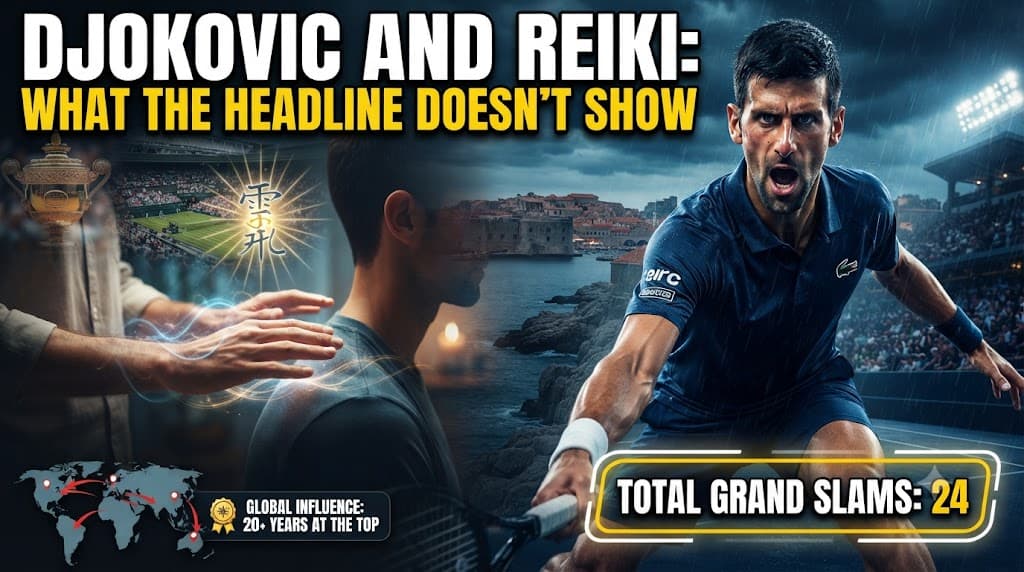
What a Djokovic Profile Actually Tells Us About Reiki (Which Is Less Than the Headline Suggests)
A major paper called him a "reiki believer" — yet the article barely mentions Reiki. Here's what it really says.
On 24 January 2026, The Indian Express published an explainer by Sandeep Dwivedi about Novak Djokovic's longevity, headlined around three labels: tree-hugger, extreme-dieter, reiki believer. The piece opens with Djokovic, aged 38, beating a 23-year-old Italian qualifier in straight sets at the Australian Open, then turns to the unconventional wellness habits that have drawn "awe and ridicule" — starting with a fig tree in Melbourne he has visited for two decades. For anyone curious about Reiki, this is worth reading carefully, because the headline promises far more than the accessible text delivers: the article is a sports-longevity feature, not evidence about Reiki, and most of it sits behind a subscription wall.
Part 1: What the Source Says
Key Points
| Item | What the source states |
|---|---|
| Publication | The Indian Express, Explained / Explained Sports section, dated 24 January 2026 |
| Author | Sandeep Dwivedi, filed from New Delhi, listed as a 5-minute read |
| Framing | Headline labels Djokovic a "tree-hugger, extreme-dieter, reiki believer" and promises "the science and superstitions" behind his run |
| Athlete | Novak Djokovic, aged 38, described as showing no signs of slowing down |
| Match cited | Beat Francesco Maestrelli, a 23-year-old Italian qualifier, in straight sets at the Australian Open on the Thursday before publication |
| Career context | 24-time Grand Slam winner |
| The tree | A 20-year association with a century-old Brazilian fig tree in Melbourne's Botanical Park, which he says "heals wounds" and keeps him company; he hugs the trunk and meditates beneath it |
| Djokovic's self-description | The standfirst notes he would prefer "open-minded" to labels like "no-vax" or "anti-science" |
| Reiki content in the readable text | None beyond the word "reiki" in the headline |
| Access | The body of the article stops after the opening passages; the rest is subscriber-only |
This summary was written from publicly available facts for explanatory purposes; see the original at the link above.
Part 2: What It Does — and Doesn't — Show
The first thing to say plainly: this is a newspaper feature about an athlete, not a study. It contains no experiment, no participants, no measurements, no control group. Whatever it eventually argues about "science and superstitions," it is a journalist's synthesis, and a synthesis is not evidence in the way a trial is.
The second thing is more awkward, and I would rather name it than paper over it. In the text available without a subscription, Reiki appears exactly once — in the headline. The readable portion covers the match result, Djokovic's age, and the fig tree he has meditated beneath for twenty years. It does not say what Reiki practice he does, how often, with whom, or what he believes it does. Anyone quoting this article as "Djokovic credits Reiki for his longevity" would be reading a claim into a headline. The honest position is: as of the accessible text, we don't know what the article says about Reiki. If you want to know, the responsible move is to read the full piece at the source.
Third, notice how the headline is built. "Tree-hugger, extreme-dieter, reiki believer" bundles three unlike things into one bag, and the bag is labelled with a word — "superstitions" — that pre-judges the contents. That is normal headline craft, not dishonesty, but it is worth seeing clearly. A daily meditation habit under a tree, a restrictive diet, and Reiki (霊気 / Reiki — literally "spirit energy"; in the Usui tradition, a hands-on practice of receiving and settling into a calm state) are not the same kind of claim and would not stand or fall together.
Fourth, and most important: even if the full article established that Djokovic practises Reiki devotedly, that would still tell us nothing about whether Reiki does anything. A single famous person is a sample of one, with no comparison group and no way to separate one habit from the dozens of others — elite coaching, sports science, genetics, sleep, recovery infrastructure — that plausibly explain a 38-year-old's fitness better than any of them. Celebrity testimony is the weakest form of evidence there is, and it is exactly as weak when it favours Reiki as when it favours a diet.
What can be concluded? That a major newspaper thinks Djokovic's unconventional habits are interesting enough to explain, and that he associates a form of contemplative practice with feeling steady. What cannot be concluded? Anything at all about whether Reiki works, for whom, or by what mechanism. On that broader question, the honest summary remains the one bodies like the US National Center for Complementary and Integrative Health give: the research is limited and the evidence inconclusive. Reiki is not medical care, and nothing in this article changes that.
Part 3: A Grounded Practitioner's Take
My instinct when I see a headline like this is not delight that a famous athlete is on our side. It is mild discomfort. Being adopted as a celebrity's quirk is not the same as being taken seriously, and the word "superstitions" in the headline tells you how the bundle is being received.
I would also gently point out that the part of the story people are laughing at — a man who has gone to the same tree for twenty years to sit quietly — is, stripped of the word "hugging," a description of a long, consistent, unhurried practice. That is the least exotic thing in the article. It is also, in my experience, the part that actually matters.
I didn't come to Reiki through the spiritual world at all. The person who first told me about it was already successful in business, getting real results in the real world, not a "spiritual" type in the slightest. That mattered to me: my very first impression of Reiki had nothing to do with the mystical image most people expect, and I've never lost that starting point. It is why I read articles like this one the way an engineer reads a spec sheet — checking what is claimed, what is measured, and what is merely implied.
So what would I take from it? Only this: a habit kept for twenty years is worth more than a dramatic experience kept for a week. In the Usui tradition we keep the five precepts (五戒 / Gokai) — just for today, do not anger, do not worry, be grateful, work diligently, be kind to others — and a short daily practice. Mine is about five minutes each morning. Not because five minutes is powerful, but because five minutes is keepable. Relaxation matters more than effort; a short session done daily beats a long one done occasionally. If Djokovic's tree does something for him, I would guess it is nearer to that than to anything the word "superstition" suggests.
None of which is a reason to start Reiki. If it doesn't interest you right now, that simply means it isn't your time yet. I never push.
FAQ
Q: Does this article prove Reiki helped Djokovic stay competitive at 38? A: No — and it doesn't claim to, at least not in the text available without a subscription. Reiki appears only in the headline there. Even a full endorsement from one athlete would be a single anecdote, with no way to separate it from training, coaching, recovery, and genetics.
Q: So is there good scientific evidence for Reiki? A: The honest answer is that the research is limited and the results are inconclusive. Studies tend to be small, often lack sham-Reiki controls or proper blinding, and the placebo question is genuinely hard to rule out. Anyone telling you the science is settled — in either direction — is overstating it.
Q: What is Reiki actually for, then? A: In the traditional Japanese Usui stream it is a practice of settling: people commonly describe feeling calmer, lighter, more rested. It is not medical care, not diagnosis, not treatment, and not a cure, and it should never replace seeing a doctor.
Q: Do I need a dramatic experience for the practice to be "working"? A: No. Many people feel very little at first, and that is completely ordinary. Consistency, not intensity, is what the tradition asks for — which is why a short daily practice is the standard advice rather than long, effortful sessions.
The Bottom Line
- The Indian Express piece (24 January 2026) frames Djokovic's longevity around three habits — tree-meditation, extreme dieting, and Reiki — under a headline that calls them "superstitions."
- In the text available without a subscription, Reiki is mentioned only in that headline; the readable portion covers his straight-sets win over Francesco Maestrelli and his twenty-year habit of meditating beneath a fig tree in Melbourne.
- The article is journalism, not research. It offers no design, no controls, no measurements — and celebrity testimony, however sincere, cannot show whether Reiki does anything.
- A grounded reading takes nothing from it about efficacy, and only one modest thing about practice: that twenty years of showing up quietly is more interesting than any single dramatic claim.
Reiki does not become truer because a champion practises it, and it does not become false because a headline calls it superstition. It stays exactly what it was — a quiet practice with limited evidence, offered honestly or not at all.
Sources
About the author
Japanese Reiki Shihan · traditional Usui Reiki, taught and certified in person
- ●Japanese Reiki Shihan (師範 / Reiki Master)
- ●Trained in the traditional Japanese Usui lineage
- ●20+ years of daily practice · teaches in person
- ●Former IT engineer & founder — grounded, no hype
I'm a Japanese Reiki Shihan who learned in the traditional Usui lineage and has practised every morning for over twenty years. My background is in IT and business, not the spiritual scene, so I write about Reiki plainly — what it is, how to practise it, and what it's honestly like — with no medical claims. Based in the Philippines, where I teach in person.
Enjoy this article?
Get honest, grounded writing on traditional Japanese Usui Reiki straight to your inbox.
Related Articles

Vogue on Energy Healing: What It Shows About Reiki
Vogue Arabia's 2026 energy healing feature offers testimony, not evidence. A Japanese Reiki teacher reads it honestly — no hype, no overclaiming.
7/11/2026

Reiki in a Cancer Center: Reading CURE's Interview
A grounded look at CURE's interview with a Reiki master at a cancer center: what her account actually shows, and what it honestly does not.
7/10/2026

Reiki and Grief: Reading One Mother's BBC Story
A grounded look at a BBC story where Reiki, CBT and meditation helped a mother grieve — and what a single personal account can and can't show.
7/9/2026

When a Sceptic Tries Reiki: An Honest FT Read
An FT sceptic tries two Reiki sessions and finds calm but no fireworks. A grounded look at what the column shows — and what it honestly can't.
7/8/2026

Reiki for Shelter Cats: What the Forbes Story Shows
A Forbes feature on a volunteer using Reiki to settle shelter cats — an honest look at what it shows, what it can't, and how to read it.
7/6/2026

Reiki and the Burnout-Era Energy Healing Trend
Vogue Singapore's energy healing feature covers Reiki, Pranic Healing and Qigong. An honest read on what a wellness trend piece can and can't show.
7/5/2026