Reiki and Grief: Reading One Mother's BBC Story
A grounded look at a BBC story where Reiki, CBT and meditation helped a mother grieve — and what a single personal account can and can't show.

Japanese Reiki Shihan (師範) · traditional Usui Reiki · 20+ years of daily practice
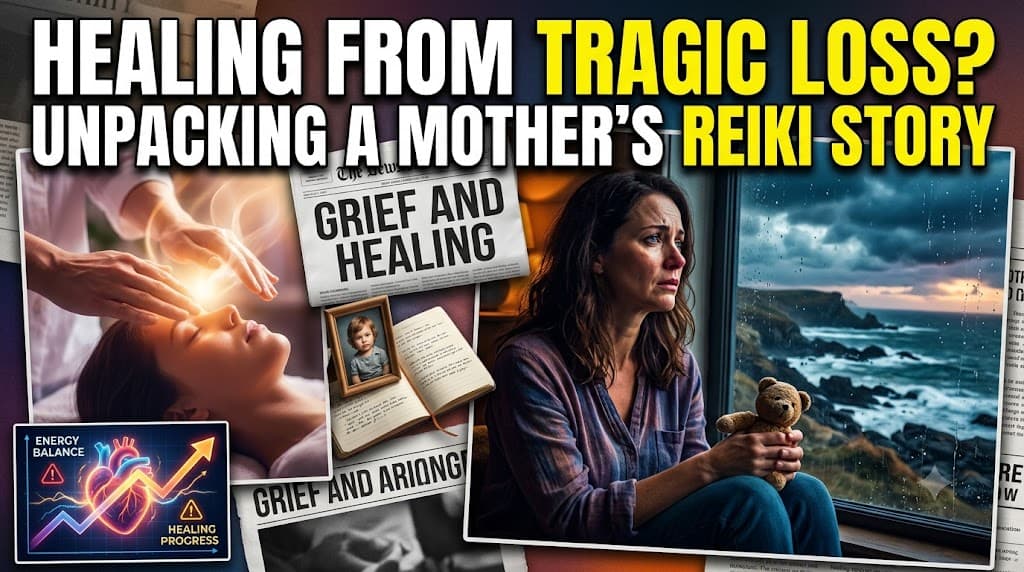
One Mother's Grief and Reiki: Reading the BBC's Story of Justina Frampton Honestly
A BBC feature says Reiki helped a Dorset mother grieve — here's what one honest story really shows.
This explainer looks at a BBC News feature published on 26 August 2025, in which a woman from Dorset, Justina Frampton, describes how Cognitive Behavioural Therapy, meditation and Reiki helped her grieve after losing her baby son and, four years later, her husband. The piece is a personal account — a first-person story of coping with loss — not a scientific study or a medical claim. For anyone curious about Reiki, it is worth reading carefully: it shows what one person felt Reiki did for her, while making clear that it sat alongside established therapy and cannot stand as proof of anything on its own. As of its publication date, this is exactly what it is — a single, human story.
Part 1: What the Source Says
Key Points
| Detail | What the source says |
|---|---|
| Source type | Personal-interest news feature (BBC News, Dorset) |
| Date published | 26 August 2025 |
| Person featured | Justina Frampton, who now works as a therapist in Dorset |
| First loss | Her son Leo died on 22 November 2019 at nine months old, after his liver began to fail |
| Leo's condition | Biliary atresia — a rare liver disease diagnosed at 11 weeks; treated at Oxford Children's Hospital, then King's College, and placed on the liver transplant list |
| Second loss | Her husband Victor died about four years later, after a car incident led to a heart attack and then brain injury from lack of oxygen |
| What she names as helping | Cognitive Behavioural Therapy (CBT), meditation and Reiki — because, she says, she had been avoiding the trauma |
| When she found Reiki | She went on a Reiki course after Leo died and came away "with a different way of thinking" |
| Recent event | She hosted her first holistic festival at Moreton Village Hall, Dorset |
BBC News — "'Reiki helped me grieve for my son and husband'" (26 August 2025) This summary was written from publicly available facts for explanatory purposes; see the original at the link above.
Part 2: What It Does — and Doesn't — Show
The first thing to be clear about is the kind of source this is. It is a personal testimony — one woman describing, in her own words, what helped her through extraordinary grief. In research terms, this is a single account (what a scientist would call an n = 1 story). It was never designed to test whether Reiki "works," and it does not have any of the features that would let it answer that question: there is no comparison group, no control, no measurement, and no attempt to separate one influence from another.
That last point matters most. Justina names three things together: Cognitive Behavioural Therapy, meditation, and Reiki. CBT is a well-established, evidence-based psychological therapy delivered by trained professionals. When someone improves after using several forms of support at once, there is simply no way — from a story like this — to know which part did what, or how much any of them mattered next to time, family, and her own resilience.
It is also worth separating the medical part of the story from the wellbeing part. Leo's illness, biliary atresia — where the ducts that carry bile from the liver do not develop properly and become blocked — was a serious medical condition treated in hospitals, on a transplant list, by doctors. Reiki does not appear anywhere in that medical picture. Where Reiki appears is later, in how Justina describes coping with her grief: it helped her stop avoiding what had happened, open up, and, in her words, have "a moment to reflect" so she could "let go."
So what does the source honestly show, and not show?
- What it shows: For this one person, Reiki — alongside professional therapy and meditation — was part of a process she credits with helping her face grief she had been avoiding and become more open about her story.
- What it does not show: That Reiki "works" for grief in general, that it caused her improvement, or that it can stand in for psychological therapy or medical care. A single, positive personal account cannot establish any of that.
This fits the broader picture from independent reviews of the research, which generally describe the evidence for Reiki as limited and inconclusive — not strong enough to draw firm conclusions in either direction. A grounded reader holds both things at once: a real, moving human experience, and honest uncertainty about what it can be taken to prove.
Part 3: A Grounded Practitioner's Take
I came to Reiki from a former engineer's habit of asking for evidence, so my instinct with a story like this is to name it for what it is: a testimony, not a trial. And I think that is fine. Stories tell us how something felt to a person living through it; they were never meant to tell us whether it works in a controlled study. Confusing the two is where hype begins, and I would rather stay on honest ground.
What I appreciate in Justina's account is that she does not lean on Reiki alone. She names Cognitive Behavioural Therapy first — real, professional support — with meditation and Reiki alongside it. That is the grounded picture. Grief of this magnitude asks for many kinds of care, and Reiki, in my tradition, was never sold to me as a replacement for any of them. What it offers is quieter than that: relaxation, a settling, a few honest minutes of stillness in which a person can stop bracing and simply be present.
Her own phrase — that "having a moment to reflect helps us let go" — lands close to how I teach. A common misunderstanding is that the harder you concentrate, or the longer you sit, the more Reiki "works." In my experience it is the opposite. Relaxation matters most, and even a short session is enough; my own honest five minutes each morning are the proof of that. I would never tell anyone that this cures grief or heals a wound. I would only say that a small, calm pause is sometimes the thing that lets a person begin to feel again — and that, in Usui's five precepts (五戒 / Gokai), the daily reminder "just for today, do not worry" is a companion to that stillness, not a cure for it.
So I read this story with respect and with restraint. It is one woman's truth about what helped her survive the unsurvivable. It is not a claim that Reiki does anything medical, and I would gently correct anyone who tried to stretch it into one.
FAQ
Q: Does this BBC story prove that Reiki helps with grief? A: No. It is one personal account, not a study. It has no control group and no measurement, and Reiki was used alongside CBT and meditation, so there is no way to know from this story what helped or how much. It shows what one person felt — not what works in general.
Q: Is Reiki a treatment for grief, trauma, or illness? A: No. Reiki is not medical or psychological treatment, diagnosis, or a cure. At most it offers relaxation and a sense of settling. For grief or trauma, professional support — such as the CBT Justina describes — and medical care where needed are the appropriate paths.
Q: Justina used CBT and meditation too. Can we tell what actually helped her? A: Not from an account like this. When several forms of support are used together, and time and personal resilience are also at work, a single story cannot separate out one cause. That is one honest limit of testimonies like this one.
Q: What does Reiki actually feel like in practice, then? A: Most people describe it simply as relaxing — a calm, settled, sometimes "lighter" feeling. In a grounded tradition it is treated as a moment of stillness, not as anything that treats a condition.
The Bottom Line
- The source is a BBC News personal story (26 August 2025) in which Justina Frampton says CBT, meditation and Reiki helped her grieve after losing her son Leo and, four years later, her husband Victor.
- It is a single testimony, not a study: no controls, no measurement, and Reiki was used alongside professional therapy — so it cannot show that Reiki "works" or that it caused anything.
- What it honestly shows is that, for this one person, Reiki was part of a process that helped her stop avoiding grief and open up; what it does not show is any medical effect or any general proof.
- A grounded practitioner reads it with respect and restraint — as a moving human story about relaxation and reflection, not as evidence and never as a cure.
Sources
About the author

Japanese Reiki Shihan · traditional Usui Reiki, taught and certified in person
- ●Japanese Reiki Shihan (師範 / Reiki Master)
- ●Trained in the traditional Japanese Usui lineage
- ●20+ years of daily practice · teaches in person
- ●Former IT engineer & founder — grounded, no hype
I'm a Japanese Reiki Shihan who learned in the traditional Usui lineage and has practised every morning for over twenty years. My background is in IT and business, not the spiritual scene, so I write about Reiki plainly — what it is, how to practise it, and what it's honestly like — with no medical claims. Based in the Philippines, where I teach in person.
Enjoy this article?
Get honest, grounded writing on traditional Japanese Usui Reiki straight to your inbox.
Related Articles
When a Sceptic Tries Reiki: An Honest FT Read
An FT sceptic tries two Reiki sessions and finds calm but no fireworks. A grounded look at what the column shows — and what it honestly can't.
7/8/2026

Reiki for Shelter Cats: What the Forbes Story Shows
A Forbes feature on a volunteer using Reiki to settle shelter cats — an honest look at what it shows, what it can't, and how to read it.
7/6/2026

Reiki and the Burnout-Era Energy Healing Trend
Vogue Singapore's energy healing feature covers Reiki, Pranic Healing and Qigong. An honest read on what a wellness trend piece can and can't show.
7/5/2026

Reiki, "Energy Healing," and Religious Worry
A Reiki teacher's honest read of a 2026 Salt Lake Tribune commentary on "energy healing," "frequency" language, and religious concern.
7/4/2026

Self-Reiki for Sleep: What "Reiki Lite" Shows
A grounded look at "self-Reiki" for sleep from a Bustle wellness piece: what the calming hands-on ritual genuinely offers, and what it doesn't.
7/3/2026

Does Reiki Actually Work? A Grounded Reading
A Reiki Master's honest look at a Verywell Mind explainer: what the small studies on relaxation and blood pressure show, and what they don't.
7/1/2026