Hand Positions for Self-Reiki: A Beginner's Map
In traditional Japanese Usui Reiki, self-Reiki hand positions are a gentle starting map — relaxation and consistency matter more than precise placement.

Japanese Reiki Shihan (師範) · traditional Usui Reiki · 20+ years of daily practice
Key Takeaways
- Self-Reiki hand positions are a scaffold for beginners, not a fixed medical protocol, and traditional Japanese practice is more forgiving about placement than many Western charts suggest.
- Relaxation, not concentration or duration, is what lets a session settle; trying harder tends to work against you.
- In this lineage the practice is carried by an in-person attunement, so resting your hands on your own body is calming but is not the same as receiving the connection properly.
Key Terms Explained
靈氣 (Reiki) / Universal Energy — connecting with the energy of the universe and letting it help life settle in a better direction.
手当て (Teate) / Laying On of Hands — literally "applying the hand"; it is also the ordinary Japanese word for care and treatment, and it sits at the heart of self-Reiki.
合掌 (Gasshō) / Palms Together — the quiet hands-together posture used to begin and to settle before practice.
丹田 (Tanden) / Lower Abdomen Center — the point a few finger-widths below the navel, a natural resting place for the hands and the breath.
Related: Traditional Japanese vs Western Reiki: 7 Differences That Actually Matter explains this in detail.
My First Two Weeks of Placing Hands
| At a glance | |
|---|---|
| First routine | About twenty minutes daily, two weeks straight |
| What I felt early | Little at first, nothing dramatic |
| First real signal | A yawn, sometimes a shiver |
| Now | Around five minutes each morning |
After my first attunement — the Level 1 靈授 (Reiju) / Attunement — I kept a simple daily routine of about twenty minutes, and I did it for two weeks without missing a day. Honestly, I didn't feel much at first. I say that plainly because so many introductions promise instant heat or tingling the moment your hands touch your body. For me, nothing dramatic happened in those early weeks. I placed my hands, I breathed, I moved through the positions, and mostly I just sat there being patient.
 Early self-Reiki is mostly quiet patience — twenty unhurried minutes with hands resting lightly on the body.
What did eventually show up was small and physical. When I practise, I often shiver, and I almost always yawn. Over time I came to read that yawn as a sign that the energy is being received — a small, repeatable marker that is genuinely useful for a beginner who is quietly worried they "aren't feeling anything."
These days my morning practice is closer to five minutes. I used to recite the precepts out loud; now I simply open my arms wide toward the window, let the energy in, and take it into my body. After all these years I feel the energy with my body rather than through words. The long sequence of hand positions was the map that got me walking. I still return to it, but I no longer need to read every line.
Related: Yawning and Shivers: The Body Signs You're Receiving Reiki explains this in detail.
Where the Hands Go, and Why It Isn't Strict
| Basic sequence | Note |
|---|---|
| Head — crown, face, back of head | Light touch or just above |
| Throat and neck | Gentle, never gripping |
| Chest and solar plexus | Rest a minute or two |
| Belly down to the tanden | Finish low, at the lower abdomen |
| Shoulders or knees | Optional close |
Reiki is not a religion, and it has nothing to do with ghosts or the occult. It is simply connecting with energy and letting life settle. The hand positions are just a practical way to guide that — a map for the body, nothing more mystical than that.
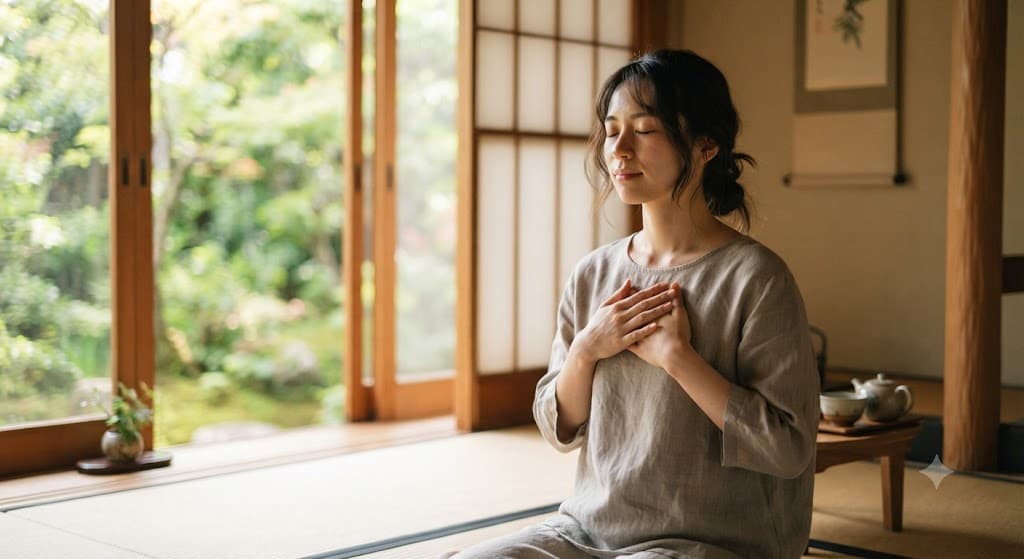
 Beginning in 合掌 (Gasshō): a few slow breaths and relaxed shoulders before the hands begin their path down the body.
Related: Self-Reiki for Sleep: What "Reiki Lite" Shows explains this in detail.
Beginning with Gasshō
Before touching anything, I settle. Hands together at the chest in 合掌 (Gasshō) / Palms Together, a few slow breaths, and a moment to relax the shoulders. This is not ceremony for its own sake; it is the switch from doing to receiving. If you skip straight to placement while still tense, you are working against the practice before it has begun.
The Basic Sequence: Head Down to the Tanden
The beginner's map is easy to remember because it simply follows the body from top to bottom. Rest your hands lightly, either touching or hovering just above, and stay at each place for a minute or two — longer if you feel like lingering, shorter if you don't.
A workable order is: the crown and top of the head; over the eyes and face; the back of the head; the throat and the sides of the neck, kept gentle and never gripping; the chest over the heart; the solar plexus just below the ribs; the belly; and finally the 丹田 (Tanden), the lower abdomen. Many people also like to finish with hands on the shoulders or resting on the knees. That is the whole map. There is no secret extra step.
Why Japanese Practice Isn't a Fixed Chart
The tidy twelve-position charts many people picture came largely out of how Reiki was systematized as it travelled West. The tradition as I received it is looser. In traditional Japanese practice the hands tend to be guided by feel — you rest where your attention is drawn and stay while it feels right. This is why I keep saying the map is a starting point, not a rulebook. Once your hands learn to listen, you stop reading it. Historically the practice was formalized and taught openly in Tokyo in the early twentieth century, and even then it was passed hand to hand, person to person, rather than as a rigid diagram.
Reading Your Own Signals
Beginners often want a checklist for "success." I would offer only this: notice what your body quietly does. A yawn, a shiver, a spreading warmth under the palms, a sense of the shoulders dropping — these are the small, honest signs that you are settling. They are not guaranteed, they are not a score, and their absence on any given morning means nothing is wrong.
What a Map Can and Can't Do
| Honest boundary | |
|---|---|
| What it doesn't do | Treat or fix any specific illness |
| What it can do | Help you feel settled and lighter |
| What matters most | Relaxation, not effort or duration |
| Session length | A short session is enough |
I spent decades as an engineer, and I still trust systems and maps by instinct. So I understand the temptation to treat hand positions like a precise circuit diagram — get every placement exactly right and the "result" will follow. In my experience it does not work that way, and pretending it does only makes people anxious about their own hands.
 The map only matters until you relax into it — a short, gentle session settles more than a long, effortful one.
Here is the honest boundary. Reiki has not been shown to treat or fix any specific illness, and I make no claim that it does. What I can say, from more than twenty years of daily practice, is that it helps me feel settled and lighter, and it has quietly turned my life in a better direction. That is what Reiki is to me — nothing more mystical than that, and nothing less.
The other honest thing is that more effort is not more Reiki. A common misunderstanding is that the harder you concentrate, or the longer you sit, the more it works. The opposite has been true for me. Relaxation matters most, and even a short session is enough. My own five honest minutes a morning are the proof. The map exists to help you relax into the practice — not to grade you, and certainly not to be followed so anxiously that you never actually settle.
FAQ
Q: Do I have to place my hands in exactly the right spot?
A: No. The head-to-tanden sequence is a guide, not a target you can miss. Resting your hands over a general area, lightly touching or just above, is enough. Comfort and relaxation matter far more than millimeters.
Q: I don't feel anything. Am I doing it wrong?
A: Almost certainly not. After my own first attunement I felt little for two weeks. Many people notice nothing dramatic at first, and then a yawn, a shiver, or a gentle warmth arrives later. Its absence is not a failure.
Q: Can I practise self-Reiki without an attunement?
A: You can rest your hands on yourself and relax, and that alone is calming. But in the Usui lineage the connection is passed in person through 靈授 (Reiju) / Attunement, so the hand positions on their own are not the same practice. If the timing isn't right for you yet, that is completely fine — there is a right moment for everything.
Key Insights to Remember
-
A beginner's map exists to be outgrown. In my early years I followed a careful sequence for about twenty minutes; these days my morning practice is roughly five minutes with my arms open toward the window. The map got me walking, and the walking eventually taught me I no longer needed to read it line by line.
-
The body learns before the words do. I used to recite the precepts aloud and think my way through each position; now I feel the energy with my body rather than through language. That shift is quiet and slow, and it is one honest sign that the practice is carrying you somewhere real.
-
Gentleness is the technique. It is tempting, especially for an analytical mind, to assume that more effort means more result. In my experience the reverse holds: relaxation matters most, and a short session is enough. The positions are only there to help you relax into the practice, not to test you.
Sources & References
- Reiki | NCCIH (National Center for Complementary and Integrative Health)
- Effects of Reiki therapy on quality of life: a meta-analysis of randomized controlled trials (PMC)
- Assessing the Ability of Reiki Practitioners to Detect Human Energy Fields — history of Usui and Reiki (OBM Integrative and Complementary Medicine)
About the author

Japanese Reiki Shihan · traditional Usui Reiki, taught and certified in person
- ●Japanese Reiki Shihan (師範 / Reiki Master)
- ●Trained in the traditional Japanese Usui lineage
- ●20+ years of daily practice · teaches in person
- ●Former IT engineer & founder — grounded, no hype
I'm a Japanese Reiki Shihan who learned in the traditional Usui lineage and has practised every morning for over twenty years. My background is in IT and business, not the spiritual scene, so I write about Reiki plainly — what it is, how to practise it, and what it's honestly like — with no medical claims. Based in the Philippines, where I teach in person.
Enjoy this article?
Get honest, grounded writing on traditional Japanese Usui Reiki straight to your inbox.
Related Articles
What to Do When a Client Falls Asleep During Reiki
People fall asleep during Reiki often, and it is neither a problem nor proof that anything worked. Why it happens, and what to do.
8/18/2026
Practising Reiki on Family: Why It Is Harder
Giving Reiki to family is harder than to a client, and the difficulty is structural: no appointment, consent muddied by obligation.
8/17/2026
Keeping a Practice Journal: The Habit That Changed Me
I started a practice journal after giving a student a confident number I could not verify. The missed days proved most useful.
8/16/2026
Reiki for a Room, Not a Person: What I Do Not Claim
I practise Reiki in spaces and say so plainly, but I will not tell a client the room has changed. On the word joka.
8/15/2026
When a Client Becomes Emotional: Handling Tears
Why the instinct to ask a crying Reiki client if they are all right is the one a practitioner most needs to unlearn, and what steady hands offer instead.
8/13/2026
Your First Reiki Session, Step by Step
What actually happens in a first Reiki session — the consent question I ask first, why feeling nothing is normal, and the things I never promise.
8/12/2026