Why Relaxation Beats Trying Hard in Reiki
Trying harder does not deepen Reiki practice; relaxation does. After more than twenty years, my own morning routine takes just five minutes.

Japanese Reiki Shihan (師範) · traditional Usui Reiki · 20+ years of daily practice
Key Takeaways
- The most common misunderstanding among beginners is that harder concentration produces more, when in practice the opposite tends to be true.
- Strain is easier to catch in the body than in the mind: the jaw, the shoulders and the hands give it away before you notice you are doing it.
- The restraint you practise inwardly is the same restraint you owe outwardly — which is why Reiki is never sent to someone who has not asked for it.
Key Terms Explained
- 靈氣 (Reiki) / Universal Energy — the practice of connecting with the energy of the universe and letting it settle your life in a better direction.
- 霊授 (Reiju) / Attunement — the transmission given in person by a teacher, traditionally the true beginning of a student's practice.
- 五戒 (Gokai) / The Five Precepts — Usui's daily principles, recited or held quietly as a way of living.
- 師範 (Shihan) / Teacher, Master — the level qualified to teach and to give attunement in the traditional lineage.
What "Trying Hard" Actually Looks Like
| Where it shows | What you would find if you checked |
|---|---|
| Shoulders | Lifted slightly toward the ears, held there |
| Jaw | Teeth just touching, or lightly clenched |
| Hands | Pressed against the body rather than resting on it |
| Breath | Shallower and higher in the chest than usual |
| Attention | A quiet commentary asking is it working yet? |
Beginners who tell me they are frustrated are usually not practising badly. They are practising hard, which is a different mistake and a harder one to spot from the inside.
The reason it is hard to spot is that effort feels like sincerity. Sitting longer, concentrating more fiercely, monitoring your palms for heat — all of it feels like taking the practice seriously. Nobody straining in this way thinks they are doing something wrong. They think they are doing more.
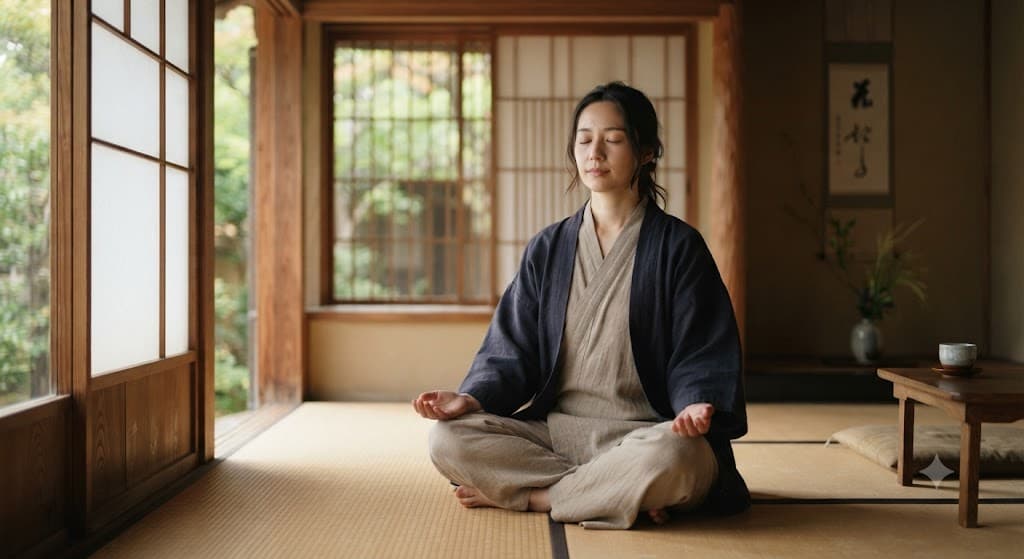
 Hands resting on the body, not pressed into it — a small difference that is easy to feel once you look for it.
The list above is worth running through once, mid-session, in the first few weeks. Not as a discipline, but as a check. Most people find at least two of the five, and are surprised.
Related: My 5-Minute Morning Reiki Routine, After 20+ Years: Why It Got Shorter, Not Longer explains this in detail.
Why the Strain Defeats Itself
| Angle | The common belief | What I have found |
|---|---|---|
| Effort | Harder concentration works better | Strain is the obstacle, not the engine |
| Monitoring | Checking for sensation keeps you engaged | Checking is what keeps you from settling |
| Intention | Wanting it strongly helps | Intention is quiet; wanting is loud |
| Consent | Sending Reiki to someone is a kindness | It is only ever sent when asked for |
Effort Is Not the Engine
 Relaxation, not concentration, is what the practice actually asks for.
Consider what "trying hard" consists of. Tension held in the shoulders. A narrowed, watchful attention. That running commentary asking whether it is working. Every element of it is the opposite of the state in which people report feeling settled and lighter.
You cannot strain your way into being relaxed. The effort is not merely unhelpful; it is the specific thing standing in the way.
I approached my own early practice the way I had approached every technical problem in a long career in IT: identify the variable, increase it, measure the result. It is a good instinct for servers. It is a poor instinct for this.
Related: Yawning and Shivers: The Body Signs You're Receiving Reiki explains this in detail.
Intention Is Quiet; Wanting Is Loud
There is a distinction worth drawing carefully here, because "just relax" is easy advice to misread.
Intention is present in the practice. You sit down on purpose. You are there deliberately. That is not passivity, and letting go of strain does not mean drifting off or going blank.
What has to go is the wanting — the leaning forward, the appetite for a result, the part of you monitoring for evidence. Intention says: I am here for this. Wanting says: give me something so I know it counted. The first is quiet enough that it does not interfere. The second fills the whole room.
Related: Does Reiki Actually Work? A Grounded Reading explains this in detail.
When You Notice You Are Straining
The useful skill is not avoiding strain. It is noticing it and setting it down, over and over, as part of the session.
When you catch it, do three things in order. Let the breath out fully — not a deep breath in, but a complete breath out, which unlocks the shoulders more reliably. Let your hands go slack where they rest. Then carry on without restarting or judging the session as spoiled.
That sequence takes about four seconds and you may need it five times in a five-minute practice. That is not a failure of the session. In the early weeks, it very largely is the session, and it is the part that transfers into the rest of your day.
Consent Is the Same Restraint, Pointed Outward
The same instinct applies outward, not only inward. Distant Reiki is never something I send to a person who has not asked. Even when I would love to help someone, I do not send it uninvited. The same holds for animals: Reiki can be given to dogs and cats, and I only ever do it with the owner's permission and at their request.
I raise it in this article deliberately, because it is the same restraint wearing different clothes. Reiki is not something you push — not onto your own body through force of concentration, and not onto another person who has not asked for it. A practitioner who has learned not to grip their own session tends to find the outward version obvious.
What an Engineer's Mind Had to Unlearn
| Question | My honest answer |
|---|---|
| Is Reiki medical care? | No. It does not diagnose or treat anything, and I make no claims about illness. |
| Is it a religion? | No, and it has nothing to do with ghosts or the occult. |
| What is it, then? | Connecting with the energy of the universe and letting it turn life in a better direction. |
| What convinced me? | Not a mystical experience, but my life slowly turning for the better. |
| Should everyone start now? | No. If it does not interest you, it is simply not your time yet. |
I spent a long career in IT and I still work as an AI engineer. That background makes me a natural skeptic, and I think that is worth bringing to Reiki rather than apologising for.
 Letting the energy in rather than reaching for it.
So let me be precise about what I am and am not claiming. Reiki is not medical care. It does not diagnose anything, and I make no claims about illness. It is not a religion, and it has nothing to do with ghosts or the occult. After more than twenty years of daily practice, here is what Reiki is to me: connecting with the energy of the universe and letting it turn my life in a better direction. Nothing more mystical than that, and nothing less.
What turned my half-belief into conviction was not a mystical experience. It was my life slowly turning for the better. I often say I "became independent" in 2000, but the truth is that I was let go from my company and had no choice but to strike out on my own. At the time it felt like the worst thing that had ever happened to me. Looking back, it was the best. When I moved to the Philippines I arrived with no plan: no work, nothing to do, no one who needed me. More than ten years later I realised that moving here was exactly what opened the biggest opportunities of my life.
Notice the shape of both stories. Neither turned on me gripping harder. They turned on me letting something happen that I had not chosen and could not force. That is the same lesson the practice teaches in miniature, every morning.
One student of mine used to be quick-tempered and took every setback badly. After learning Reiki he told me he had become able to see things positively, and that he had gone on to recommend it to his own mother. He did not achieve that by straining. He achieved it by settling.
And if Reiki does not interest you right now, I think that simply means it is not your time yet. There is a right moment to learn anything, and when yours comes you will often find you have started before you even decided to. I never push.
FAQ
Q: How do I tell the difference between relaxing and simply losing interest?
A: Check whether you would notice if the session ended early. A relaxed practitioner is still present and would notice; a drifting one would not. Relaxation removes the strain, not the attention. If you find yourself genuinely somewhere else, come back — gently, without treating it as a lapse.
Q: I have a physically demanding job and my shoulders are always tense. Does that block the practice?
A: No. Habitual physical tension is not the same as the strain of trying, and the practice is not waiting for you to become loose before it will start. Do the full breath out at the beginning, let the hands rest rather than press, and leave the rest of the body as it is.
Q: Should I stop reciting the Five Precepts if reciting them feels effortful?
A: Not stop — but you can hold them quietly rather than saying them aloud. After many years my own practice moved from words to something I feel with the body. If the reciting has become a task you are performing correctly rather than something you are living, that shift is usually the right one to make.
Q: My teacher says relax, but I want to improve. Are those in conflict?
A: They are not, though it takes a while to believe. Improvement in this practice comes from returning daily and from catching the strain sooner each time — not from applying more force per session. The wish to improve is fine. It just needs to be spent on consistency rather than intensity.
Key Insights to Remember
- Effort has a place in life, but it is not the currency of this practice. Everything that makes "trying hard" feel productive elsewhere — the tension, the monitoring, the pushing — is precisely what gets in the way here. Learning Reiki often means unlearning the reflex to grip.
- Strain is easier to find in the body than in the mind. The shoulders, the jaw and the hands report it before you have any thought about it, which makes them the practical place to check.
- The restraint you practise inwardly is the same restraint you owe outwardly. Not forcing your own session and not sending Reiki to someone who has not asked for it are two expressions of one attitude. In both cases, the thing being resisted is the urge to push.
Sources & References
About the author

Japanese Reiki Shihan · traditional Usui Reiki, taught and certified in person
- ●Japanese Reiki Shihan (師範 / Reiki Master)
- ●Trained in the traditional Japanese Usui lineage
- ●20+ years of daily practice · teaches in person
- ●Former IT engineer & founder — grounded, no hype
I'm a Japanese Reiki Shihan who learned in the traditional Usui lineage and has practised every morning for over twenty years. My background is in IT and business, not the spiritual scene, so I write about Reiki plainly — what it is, how to practise it, and what it's honestly like — with no medical claims. Based in the Philippines, where I teach in person.
Enjoy this article?
Get honest, grounded writing on traditional Japanese Usui Reiki straight to your inbox.
Related Articles

What to Do When a Client Falls Asleep During Reiki
People fall asleep during Reiki often, and it is neither a problem nor proof that anything worked. Why it happens, and what to do.
8/18/2026

Practising Reiki on Family: Why It Is Harder
Giving Reiki to family is harder than to a client, and the difficulty is structural: no appointment, consent muddied by obligation.
8/17/2026

Keeping a Practice Journal: The Habit That Changed Me
I started a practice journal after giving a student a confident number I could not verify. The missed days proved most useful.
8/16/2026

Reiki for a Room, Not a Person: What I Do Not Claim
I practise Reiki in spaces and say so plainly, but I will not tell a client the room has changed. On the word joka.
8/15/2026
When a Client Becomes Emotional: Handling Tears
Why the instinct to ask a crying Reiki client if they are all right is the one a practitioner most needs to unlearn, and what steady hands offer instead.
8/13/2026
Your First Reiki Session, Step by Step
What actually happens in a first Reiki session — the consent question I ask first, why feeling nothing is normal, and the things I never promise.
8/12/2026