Energy Healing Searches Hit a High — A Reiki Take
The AJC reports record "energy healing" searches in 2026. What that trend actually shows about Reiki — and what it plainly does not.

Japanese Reiki Shihan (師範) · traditional Usui Reiki · 20+ years of daily practice
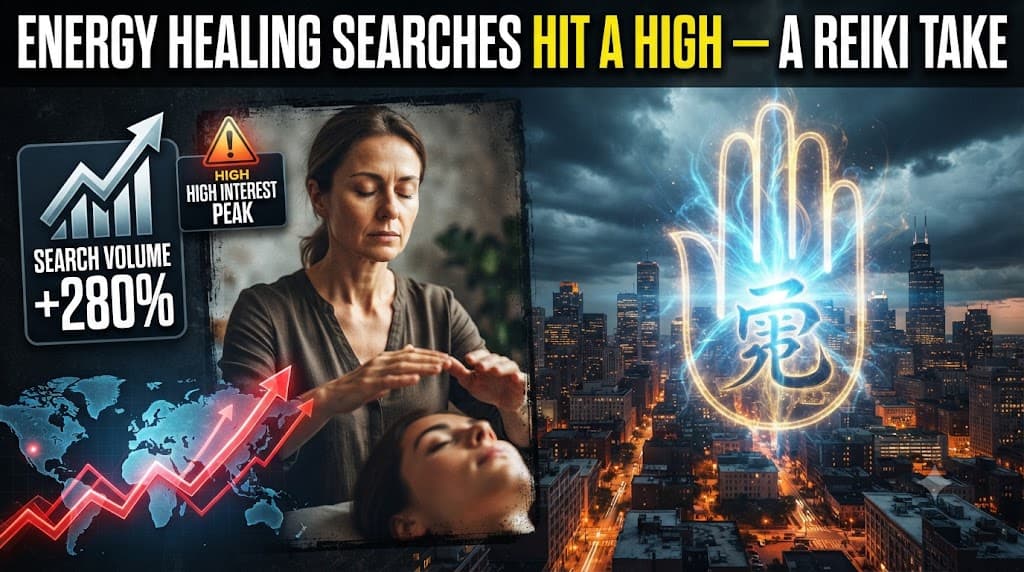
Searches for energy healing hit an all-time high in 2026. Curiosity is rising — but evidence isn't.
In April 2026, The Atlanta Journal-Constitution reported that searches for "energy healing" had reached an all-time high, while searches for "how to be spiritual" had climbed to a 15-year peak. The article builds its story around Rolene Jaffe, an Atlanta practitioner of more than thirty years who works with Reiki, tapping and body-centred methods, and who reads the spike as a response to widespread stress and unprocessed pain. It is a piece about demand — about what people are looking for — and that is worth reading carefully, because rising curiosity is not the same thing as rising evidence. For anyone considering Reiki, the useful question is not "is it trending?" but "what is actually being claimed here, and on what basis?"
Part 1: What the Source Says
Key Points
| What the article reports | Detail as given in the source |
|---|---|
| Search interest | Searches for "how to be spiritual" at a 15-year high; interest in "energy healing" at an all-time high in 2026, according to the search engine |
| Central figure | Rolene Jaffe, a healing practitioner in Atlanta with more than 30 years of practice |
| Her explanation for the trend | She tells the AJC that people are widely traumatised right now |
| Her modalities | Reiki, emotional freedom technique (EFT) tapping, and "journey work"; she declines the label "therapist" and calls herself a "multidimensional healer" |
| Her method | Guided inward work — meditation, body scan, visualisation — asking the body rather than the narrative to lead |
| Scientific framing used in the piece | Neuroscience research showing that trauma produces lasting nervous-system changes; Bessel van der Kolk's 2014 book The Body Keeps the Score |
| Market figure cited | The global somatic therapy market is projected to nearly triple by 2032, reaching $12.4 billion, per market research firm Coherent Market Insights |
| Other cultural signals | "Spiritual stores" breaking out in local search (Google Trends); oracle decks, aura readings and new-moon rituals treated as ordinary |
| Commercial context | Jaffe released her own Rise & Radiate oracle cards last December; she hosts at 7th House, an astrology-themed Atlanta restaurant part-owned by her son, Alexander Sher, where GM Trenton Austin built a zodiac-aligned cocktail menu |
The Atlanta Journal-Constitution — "A surge in 'energy healing' searches points to something deeper" (April 23, 2026) This summary was written from publicly available facts for explanatory purposes; see the original at the link above.
Related: How Distant Reiki Works — and Why I Never Send It Uninvited explains this in detail.
Part 2: What It Does — and Doesn't — Show
Start with what this source actually is: a wellness feature in a metropolitan newspaper, built around one practitioner's perspective and some search and market data. It is not a study. It reports no experiment, no participants, no control group, no outcome measure. Nothing in it tests whether Reiki or any other energy-healing method does anything at all.
What it does show, honestly. Two things, and they are real. First, a lot more people are typing these words into a search bar than used to. Second, at least one long-practising professional and a growing commercial ecosystem are meeting that curiosity. Interest is measurable, and it is up.
What search volume cannot tell you. A search is a question, not a verdict. People search "energy healing" because they are curious, because a friend mentioned it, because they are sceptical and want ammunition, or because a trend piece told them it was trending. The number tracks attention. It says nothing about whether the thing being searched works, and no honest practitioner should present it as if it did.
Where reporting shades into framing. The article places trauma neuroscience and The Body Keeps the Score alongside Jaffe's practice. The neuroscience is legitimate on its own terms — the claim that stress and trauma leave lasting marks on the nervous system is not controversial. But the piece invites a leap it does not demonstrate: that because the body carries stress, body-centred spiritual modalities therefore resolve it. Van der Kolk's book is not a study of Reiki. Adjacency is not evidence. This is the single most important thing to notice in the article, and it is the kind of slide that happens constantly in wellness writing.
Testimonial versus data. Jaffe's account of clients shifting something they had carried for years is sincere and, in my experience, the sort of thing practitioners genuinely see. It is also uncontrolled, unblinded, self-selected and self-reported — the weakest form of evidence there is, not because the people are lying but because it cannot rule out expectation, relief at being listened to, natural change over time, or the ordinary comfort of an hour of quiet attention. Mainstream research bodies reviewing this field consistently describe the evidence for Reiki and similar practices as limited and inconclusive. Nothing in this article changes that.
Follow the money, gently. The $12.4 billion projection is a forecast from a market research firm, not an outcome measurement — it describes what people are expected to spend, not what they will get. And the article's central figure sells an oracle deck and works at a themed restaurant with a family stake. None of that makes her insincere. It does mean a reader should hold the framing loosely.
A note on terms. 靈氣 / 霊気 (Reiki) is usually rendered as "universal energy" or "spiritual energy." In the traditional Japanese Usui stream it is a practice of daily self-cultivation first, with hands-on work second. What English-language media calls "energy healing" is a much broader umbrella — it includes methods with no relationship to Reiki at all, and lumping them together is one reason public conversation about this stays muddled.
Related: An Engineer's Honest Take on Reiki: What I Am Willing to Claim, and What I Am Not explains this in detail.
Part 3: A Grounded Practitioner's Take
I read an article like this with a certain wariness, because the version of spirituality it describes — oracle decks, aura readings, zodiac cocktails — is exactly the image that puts thoughtful people off before they ever get near an actual practice. And I understand that reaction, because I did not come to Reiki through the spiritual world at all. The person who first told me about it was someone already successful in business, getting real results in the real world — not a "spiritual" type in any sense. That mattered enormously. My very first impression of Reiki had nothing to do with the mystical image most people expect, and I have never needed the mystical packaging since.
So when the article's practitioner draws a line between "dabbling" and "doing the work," I think she is pointing at something true, even if the surrounding aesthetic obscures it. In the traditional Japanese line I trained in, the work is unglamorous. 五戒 (Gokai) — the Five Precepts — are the whole architecture: just for today, do not anger, do not worry, be grateful, work diligently, be kind to others. That is not a trend. It is a set of instructions for a Tuesday morning. My own daily practice now takes about five minutes. Nothing about it would photograph well.
I also want to be plain about what I am not claiming. Reiki is not medical care. It does not diagnose, treat or cure anything, and no search-volume chart or market forecast changes that. What people reliably report — and what I would describe from my own practice — is relaxation: feeling settled, a little lighter, less clenched. That is a modest claim, and I would rather make a modest claim I can stand behind than a large one I cannot.
If the surge in searches means anything worth celebrating, I think it is this: a lot of people are quietly admitting they are tired and would like to feel calmer. That is an honest starting point. Whether Reiki turns out to be the thing that helps them is not something a headline can decide, and it is not something I would ever push. If it does not interest you right now, I think it simply means it is not your time yet.
FAQ
Q: Does a spike in search interest mean energy healing is being validated? A: No. Search volume measures curiosity, not effectiveness. The two are entirely independent. A method could be enormously popular and still lack good supporting evidence — and the honest position on Reiki today is that the research evidence remains limited and inconclusive.
Q: The article mentions trauma neuroscience and The Body Keeps the Score. Doesn't that support Reiki? A: It supports the general idea that stress leaves lasting physiological traces. It does not test Reiki, and it is not a study of Reiki. Placing the two side by side in an article creates an impression of scientific backing that the underlying research has not provided.
Q: Is Reiki the same as "energy healing"? A: Not exactly. "Energy healing" is a broad media umbrella covering many unrelated practices. Reiki in the traditional Japanese Usui stream is a specific practice with a defined lineage, a daily self-practice, and the Five Precepts at its centre. Conflating them makes it harder to have a clear conversation about any of them.
Q: What can Reiki honestly be expected to do? A: People commonly report relaxation — feeling calmer, settled, somewhat lighter after a session or after regular self-practice. That is the honest description. Reiki is not medical care, is not a treatment for illness, and should never replace a doctor.
The Bottom Line
- The AJC reports that "energy healing" searches hit an all-time high in 2026 and "how to be spiritual" a 15-year high, framed through one Atlanta practitioner's thirty years of work and a projected $12.4 billion somatic therapy market by 2032.
- What it genuinely shows: interest is rising, and a commercial ecosystem is growing around it. What it does not show: that Reiki or any energy-healing method works — there is no study, no control, no measured outcome anywhere in the piece.
- The article's most important weak seam is the slide from real trauma neuroscience to spiritual modalities. Adjacency is not evidence, and testimonial is the weakest evidence there is.
- Read as a practitioner: rising curiosity is a fair starting point, not a verdict. The practice itself remains ordinary, daily and modest — relaxation, the Five Precepts, a few honest minutes a morning. Nothing more, and nothing less.
A trending search term proves that people are asking. It never proves that anyone has answered.
Sources
About the author
Japanese Reiki Shihan · traditional Usui Reiki, taught and certified in person
- ●Japanese Reiki Shihan (師範 / Reiki Master)
- ●Trained in the traditional Japanese Usui lineage
- ●20+ years of daily practice · teaches in person
- ●Former IT engineer & founder — grounded, no hype
I'm a Japanese Reiki Shihan who learned in the traditional Usui lineage and has practised every morning for over twenty years. My background is in IT and business, not the spiritual scene, so I write about Reiki plainly — what it is, how to practise it, and what it's honestly like — with no medical claims. Based in the Philippines, where I teach in person.
Enjoy this article?
Get honest, grounded writing on traditional Japanese Usui Reiki straight to your inbox.
Related Articles
A Reiki Trial That Included a Sham Group
A 2026 trial compared Reiki against sham Reiki in 60 ventilated ICU patients. An honest reading of what the results support.
8/18/2026

Why Most Reiki Studies Cannot Be Compared With Each Other
People ask what the research says as though the studies can be added together. Four ordinary differences block comparison.
8/17/2026

What the Reiki Trials Now Running Will and Will Not Settle
Fourteen Reiki trials are registered as recruiting or active. Twelve enrol under 100 people and four have no blinding.
8/16/2026

Why I Send People to NCCIH: Reiki Not Clearly Shown to Work
A federal health agency says Reiki has not been shown effective. A practitioner explains why he quotes it in full.
8/15/2026
Ten Brazilian Nurses, Five Reiki Sessions, No Control Group
A 2025 Brazilian study interviewed ten nurses after five Reiki sessions. Reading it honestly means knowing what it cannot show.
8/14/2026

Ten Years of Hospital Reiki and What the Anxiety Data Says
A cancer institute's ten-year Reiki programme and an 824-person anxiety meta-analysis say different things, and the honest reading sits in the gap between them.
8/13/2026