Lili Reinhart, Reiki Master: A Careful Reading
Lili Reinhart says she's a Reiki master. A Japanese Usui teacher reads the Marie Claire interview plainly: what it shows, what it doesn't, and why.

Japanese Reiki Shihan (師範) · traditional Usui Reiki · 20+ years of daily practice
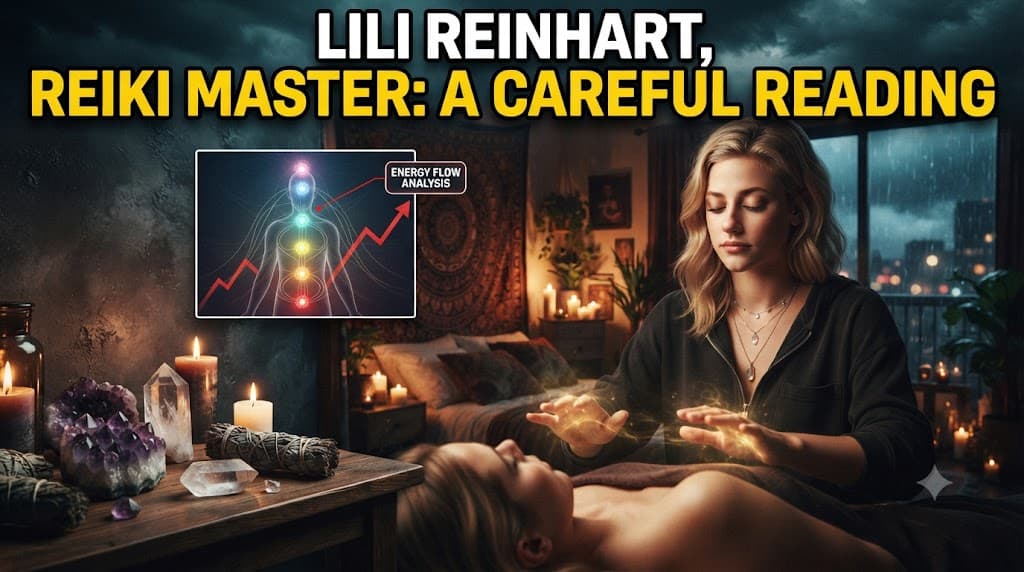
A celebrity interview put Reiki in the headlines. Here's what it actually says — and what it can't.
In November 2025, Marie Claire published a write-up of a "Nice Talk" podcast episode in which actor Lili Reinhart spoke with editor-in-chief Nikki Ogunnaike about life after Riverdale — her production work, her skincare brand, and, briefly, her Reiki training. It is a culture interview, not a health story and not a study: the Reiki content is a few paragraphs of personal reflection about why she started and what she was going through at the time. That distinction matters, because celebrity mentions are often the first place an English-speaking reader ever encounters the word "Reiki," and they carry no evidence about whether Reiki does anything measurable. What follows is a plain reading of what the piece actually says, what it cannot tell us, and how a traditional Japanese practitioner hears it.
Part 1: What the Source Says
Key Points
| Item | What the article states |
|---|---|
| Format | A Marie Claire culture piece by Lia Beck, published November 13, 2025, covering an episode of the "Nice Talk" podcast |
| The conversation | Lili Reinhart, 29, in conversation with editor-in-chief Nikki Ogunnaike, recorded at Marie Claire's Power Play event in Philadelphia in September |
| Career context | Seven seasons as Betty Cooper on Riverdale; now choosing projects deliberately, including Hal & Harper, a Mubi dramedy that premiered in October with Mark Ruffalo and creator Cooper Raiff, on which she is also an executive producer |
| Other ventures | Her production company, Small Victory Productions, and her skincare line, Personal Day — deliberately launched without her name on the packaging or her face across its social accounts |
| Why she began Reiki | Her account places the start of her training in the aftermath of a relationship she characterizes as harmful, at a stage when therapy sessions alone no longer felt sufficient for the work she needed to do |
| Prior exposure | Reiki had been performed on her several years earlier, and the physical feeling it produced was something she recalls positively |
| Her description of Reiki | She frames the practice as engaging the body's own energy via the chakra system |
| Where she is now | She holds the rank of Reiki master, a status she reports lightly rather than solemnly, offering no firm account of how she arrived there |
| What the article does not contain | No health claims, no clinical outcomes, no research, no discussion of lineage, training length, or teacher |
Marie Claire — "Lili Reinhart on Her Reiki Journey, Celebrity Beauty Fatigue, and Doing Hollywood Differently" (November 13, 2025) This summary was written from publicly available facts for explanatory purposes; see the original at the link above.
Related: Reiki's Round Trip: How a Japanese Practice Left Home and Came Back Through the West explains this in detail.
Part 2: What It Does — and Doesn't — Show
What it is
This is an entertainment interview. Its subject is a career pivot: an actor deciding how she wants to work after a long-running series, and the projects that make her feel like herself. Reiki appears inside that frame, as one thread among acting, producing, and a beauty brand. The article reports what she said. It does not test, verify, or evaluate any of it, and it does not claim to.
Related: Where Reiki Needs Extra Care: Pregnancy, Children, and the Very Elderly explains this in detail.
What it therefore cannot show
- It is not evidence about Reiki. One person's recollection — in a podcast, months after the fact — is testimony, not data. There is no comparison group, no measurement, no independent observer, and no way to separate Reiki from everything else that changes when someone leaves a painful relationship: time, distance, therapy, friends, sleep, work they enjoy.
- It says nothing about training. "Reiki master" is not a regulated title. In the article there is no mention of which stream she trained in, with whom, over what period, or to what standard. Standards vary enormously between schools, and the same phrase can mean a weekend or many years.
- It makes no medical claim, and neither should we. She speaks about wanting to take her own healing into her own hands after a hard chapter, and about liking how a session felt. That is emotional and personal language, not a claim of treatment or cure — and it is worth keeping it exactly that size.
- The chakra framing is one vocabulary, not the only one. Her description leans on chakras, an idea drawn from Indian tradition and common in Western Reiki teaching. Traditional Japanese Usui Reiki — 臼井靈氣療法 (Usui Reiki Ryōhō) / the Usui method of Reiki practice — generally does not build its practice around a chakra map at all. Neither framing is proof of anything; they are simply different languages that different schools use.
On the evidence question
The honest position on Reiki's clinical effects is the careful one. Research to date is limited, mostly small, often unblinded, and inconsistent, and bodies such as the U.S. National Center for Complementary and Integrative Health describe the evidence for Reiki as insufficient to draw firm conclusions about whether it is helpful for any health condition. This Marie Claire piece does not change that in either direction. It is not a study, and reading it as one — for or against — would be a mistake.
What the article does show is real in its own way: that a well-known person found the practice meaningful during a difficult period, and said so plainly, including the slightly embarrassed laugh at the end. That is a data point about culture, not about physiology.
Part 3: A Grounded Practitioner's Take
I read a piece like this the way I read most Reiki coverage: with interest, and with the volume turned down. Nothing here proves anything, and nothing here needs to. A person went through something hard, found that talking had taken her as far as it could for the moment, remembered a session she had liked, and went to learn it. That is an ordinary, human sequence, and it is roughly how a great many people arrive at Reiki — not through belief, but through a season where the usual tools ran short.
Two things in her account are worth separating, though.
The first is the vocabulary. Chakras are a familiar frame in Western Reiki, and there is no need to argue with it. But it is not what I was taught. I learned in the traditional Japanese Usui stream, the lineage that traces back to Mikao Usui (臼井甕男), rather than through Western Reiki — and in that stream the practice is quieter and plainer than the popular image suggests: sitting, breathing, hands, and 五戒 (Gokai) / the Five Precepts. Just for today: do not anger, do not worry, be grateful, work diligently, be kind to others. That is the daily substance of it. When people hear "energy" and "chakras" and expect something cinematic, they are often disappointed by how modest the actual practice is — and, in my experience, that modesty is the point.
The second is the word master. It travels badly. In English it sounds like an achievement or a certificate; in the Japanese line, 師範 (Shihan) simply means one who is qualified to teach. I trained all the way to Shihan for one plain reason: as a teacher I can help more people let Reiki turn their lives the way it turned mine, and staying only a receiver felt like keeping to myself something that was meant to be passed on. Reinhart's reason, as she tells it, was different and equally legitimate — she wanted the practice in her own hands. Both are fine. But when a reader sees the title in a headline, it is worth remembering that the word carries no information about how much training stands behind it, in her case or anyone's.
And if the article leaves you curious rather than convinced, that seems to me the correct place to land. Curiosity is enough. If Reiki does not interest you right now, I think it simply means it is not your time yet — and if it does, no celebrity needs to be the reason.
FAQ
Q: Does this interview mean Reiki works? A: No. It is a personal account in an entertainment interview — no measurement, no comparison, no controls. It tells us that one person found the practice meaningful in a difficult period. Whether Reiki produces effects beyond relaxation and expectation is a separate question, and the research so far is limited and inconclusive.
Q: What does "Reiki master" actually mean? A: In the Japanese tradition the equivalent term is 師範 (Shihan), meaning someone qualified to teach. The title is not regulated, and standards differ widely between schools and streams. It says nothing on its own about how long someone trained or with whom, so it is worth asking rather than assuming.
Q: She mentions chakras. Is that part of traditional Japanese Reiki? A: Not typically. Chakras come from Indian tradition and are widely used in Western Reiki teaching, but the traditional Japanese Usui stream generally does not organise its practice around them. Different schools, different vocabulary — neither one validates or invalidates the other.
Q: She says talk therapy had taken her only so far. Is Reiki an alternative to therapy? A: No, and it should not be presented that way. Reiki is not medical or psychological care, and it does not diagnose or treat anything. What people commonly report is feeling settled, lighter, or more relaxed. Anyone dealing with something serious should be working with an appropriate professional; Reiki sits alongside a life, not in place of care.
The Bottom Line
- Marie Claire's November 2025 piece is a culture interview: Lili Reinhart talks about her post-Riverdale choices, her production company and skincare brand, and — briefly — beginning Reiki training after a painful relationship and becoming a Reiki master.
- It shows that one well-known person found the practice personally meaningful. It does not show that Reiki has any measurable clinical effect, and it makes no such claim; the broader evidence on Reiki remains limited and inconclusive.
- The word "master" and the chakra framing both come from a particular lineage and vocabulary; neither tells you how much training stands behind the title, and neither settles any question of efficacy.
- Read as a piece of testimony it is honest and rather relatable; read as proof — in either direction — it is nothing at all.
A celebrity mention is a doorway, not an argument. What lies behind the door is quieter than the headline: a short daily practice, five precepts, and a willingness to find out for yourself.
Sources
About the author
Japanese Reiki Shihan · traditional Usui Reiki, taught and certified in person
- ●Japanese Reiki Shihan (師範 / Reiki Master)
- ●Trained in the traditional Japanese Usui lineage
- ●20+ years of daily practice · teaches in person
- ●Former IT engineer & founder — grounded, no hype
I'm a Japanese Reiki Shihan who learned in the traditional Usui lineage and has practised every morning for over twenty years. My background is in IT and business, not the spiritual scene, so I write about Reiki plainly — what it is, how to practise it, and what it's honestly like — with no medical claims. Based in the Philippines, where I teach in person.
Enjoy this article?
Get honest, grounded writing on traditional Japanese Usui Reiki straight to your inbox.
Related Articles

A Reiki Trial That Finally Included a Sham Group
A 2026 trial compared Reiki against sham Reiki in 60 ventilated ICU patients. An honest reading of what the results support.
8/18/2026

Why Most Reiki Studies Cannot Be Compared With Each Other
People ask what the research says as though the studies can be added together. Four ordinary differences block comparison.
8/17/2026

What the Reiki Trials Now Running Will and Will Not Settle
Fourteen Reiki trials are registered as recruiting or active. Twelve enrol under 100 people and four have no blinding.
8/16/2026

The Page I Send People To Says Reiki Does Not Work
A federal health agency says Reiki has not been shown effective. A practitioner explains why he quotes it in full.
8/15/2026
Ten Nurses, Five Sessions, No Control Group
A 2025 Brazilian study interviewed ten nurses after five Reiki sessions. Reading it honestly means knowing what it cannot show.
8/14/2026

Ten Years of Hospital Reiki, and the Sentence Buried
A cancer institute's ten-year Reiki programme and an 824-person anxiety meta-analysis say different things, and the honest reading sits in the gap between them.
8/13/2026