When a Client Becomes Emotional: Handling Tears
Why the instinct to ask a crying Reiki client if they are all right is the one a practitioner most needs to unlearn, and what steady hands offer instead.

Japanese Reiki Shihan (師範) · traditional Usui Reiki · 20+ years of daily practice
Key Takeaways
- Tears during a session are common enough that a practitioner should have a plan for them before the first one arrives, and that plan should be about restraint rather than intervention.
- A Reiki practitioner is not a counsellor, and the most useful thing to do when someone begins to cry is usually to keep doing exactly what you were doing while making it obvious they may stop at any time.
- The line you must not cross is asking why, because the moment you ask, you have moved from offering a quiet hour to conducting an interview nobody agreed to.
Key Terms Explained
手当て (Teate) / Hand Placement — the plain word for laying hands on or near the body; useful precisely because it claims nothing beyond what it describes.
施術者 (Sejutsusha) / Practitioner — the person giving Reiki, and specifically not a medical or psychological professional.
間 (Ma) / Interval, Pause — the deliberate empty space in Japanese music, speech and architecture; the single most useful concept I know for handling a client's tears.
五戒 (Gokai) / The Five Precepts — Usui's daily principles, which open with today only, and which apply to the practitioner far more than to the client.
The First Time It Happened to Me
She was perhaps thirty minutes in, lying still, and I was working near her shoulders when I noticed that the side of her face was wet.
She had not made a sound. Nothing had changed in her breathing that I could detect. If I had been standing a metre further away I would not have known at all.
My first instinct was to stop and ask if she was all right. I am glad I did not, though at the time it was closer to freezing than to wisdom. I kept my hands where they were, finished the position, and moved on. She cried quietly for perhaps ten minutes and then stopped, and at the end of the hour she sat up, thanked me, and said almost nothing about it.
More than twenty years later, I have come to think that the instinct to ask is the thing a practitioner most needs to unlearn.
Why Asking Is the Wrong Move
It converts a session into a conversation
The whole structure of a Reiki session is that the client does not have to perform. They lie down, they close their eyes, and for an hour nobody wants anything from them. That is most of what the hour is.
The moment I say "are you all right?", I have handed them a task. Now they must produce an answer, manage my concern, and decide how much to disclose to someone they may have met forty minutes ago. Their hour has become my hour.
Related: What to Do When a Client Falls Asleep During Reiki explains this in detail.
It implies something has gone wrong
There is a second, quieter message inside the question. Asking treats the tears as a problem that has interrupted the session. For many people they are not an interruption. They are the first time that week their body has been left alone long enough for something to surface.
If I react as though a fault has occurred, I have told them that this room is not a place where that is allowed.
Related: Your First Reiki Session, Step by Step: What Happens, and What I Never Promise explains this in detail.
I am not qualified for what comes next
This is the part practitioners least like to hear. If I ask why someone is crying and they tell me, I am now holding material I have no training to handle. I am not a counsellor, not a therapist, not a doctor. Reiki is not treatment for grief, trauma or depression, and I have no business acting as though an afternoon of good intentions substitutes for a qualification.
The honest position is that I can offer a quiet hour and steady hands. Anything past that belongs to someone else.
Related: Reiki Is Being Added to Hospice Programmes. Here Is What It Can Honestly Offer at the End of Life explains this in detail.
What I Actually Do Instead
I keep going, and I change nothing
The single most useful thing is continuity. I stay on my schedule of positions, I keep the same pace, and I do not slow down or speed up. The client, eyes closed, can feel that nothing has been disrupted. Nothing needs explaining.
I make the exit obvious in advance
Before every session I say some version of the same short sentence: you can ask me to stop at any point, and you do not have to give a reason. I say it before we begin, because saying it in the middle would draw attention to whatever has just happened.
That advance permission does most of the work. If they want the session to end, they can end it, and they know it without me checking.
I let the silence sit
Japanese has a word for the interval, 間 (ma), the deliberate gap in music or speech that carries as much as the notes around it. In practice this means I do not fill the room with reassurance. I do not say "it's okay to cry." I do not murmur sympathy. Comfort delivered out loud is still an intrusion, and it still requires a response.
I keep tissues within reach and say nothing about them
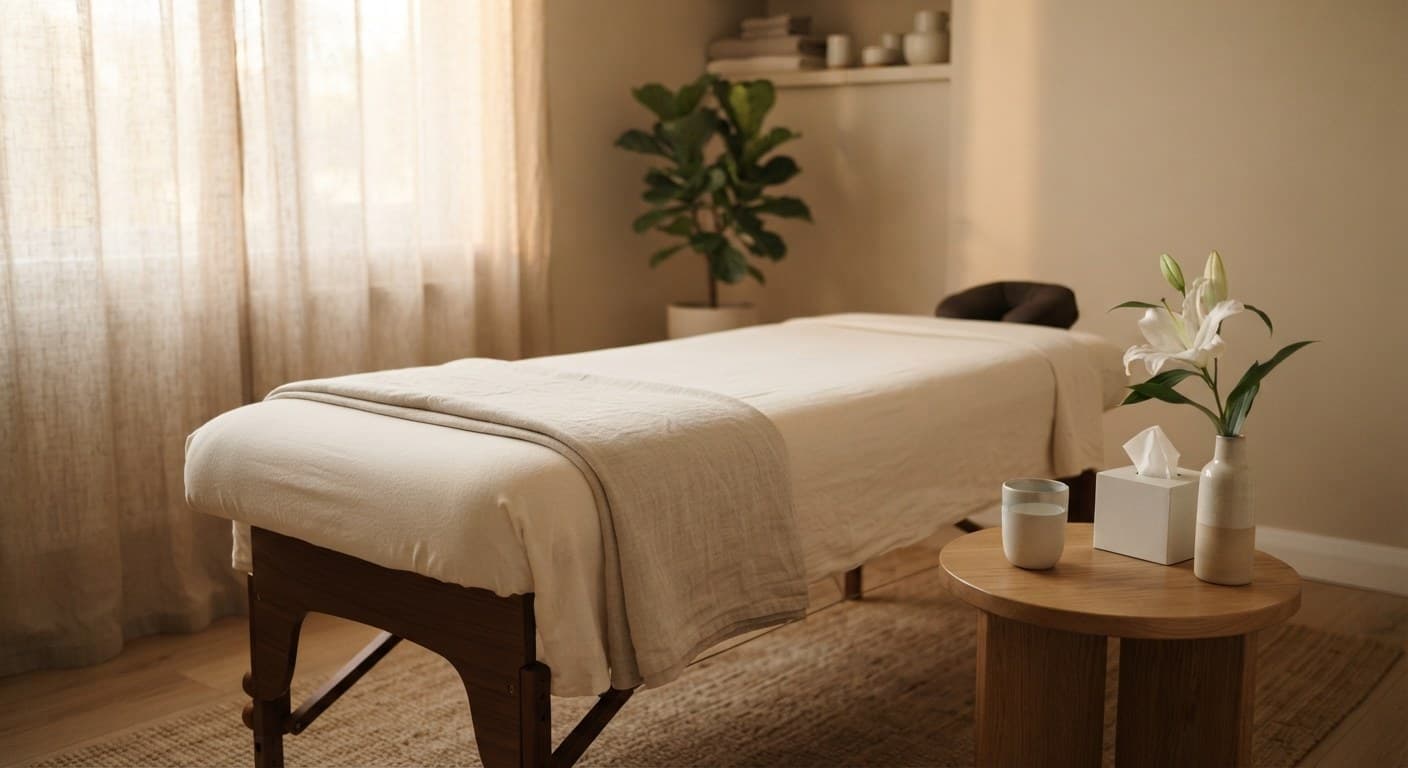
There is a box on the low table, always, in the same place, mentioned once at the start along with everything else in the room. Nobody has to ask, and I never hand them over. Reaching for a tissue is something a person can do for themselves without it becoming an event.
At the end, I offer an opening and let it close
When the hour finishes I say what I always say, which is that they can take their time getting up and that water is there if they want it. Sometimes I add a single neutral line: if you want to say anything, I'm here, and if you don't, that's completely fine.
Most people say nothing. A few say a sentence or two. Almost nobody wants a discussion, and the ones who do are usually asking for a referral rather than a conversation with me.
The Precepts Point at the Practitioner, Not the Client
Something changed in how I understood this once I started reading the 五戒 (Gokai) as instructions for the person giving rather than the person receiving.
Do not anger. Do not worry. I had always taken those as things I hoped a client would feel by the end. They are more useful as things I must manage during the session. The urge to ask why someone is crying is, in almost every case, my own discomfort looking for relief. I want the situation resolved because unresolved situations make me anxious. That is my problem to sit with, not theirs to answer.
After more than twenty years of daily practice, what Reiki is to me is simple: connecting with the energy of the universe and letting it turn my life in a better direction. Nothing more mystical than that, and nothing less. It does not make me perceptive about other people's inner lives. It does not qualify me to interpret anybody's tears. Believing otherwise is how practitioners drift into roles they were never trained for.
What Living Abroad Taught Me About Restraint
Living outside Japan for many years has made me notice how differently silence is read.
In Manila, a long pause in conversation is usually filled. Someone will say something kind, offer food, make a joke to lift the mood. It is warm and it is generous, and I have benefited from it more times than I can count. But I have also watched people be talked out of a feeling they were only halfway through having.
I absorbed a great deal from living abroad, and yet the deepest layer of how I work stayed Japanese. Leaving a gap open. Not naming the obvious. Trusting that someone can be present with their own experience without being guided through it.
That is not superior. Sometimes people genuinely want to be comforted out loud, and reading them wrongly is its own failure. But in a Reiki session specifically, where the client cannot see my face and has agreed only to an hour of hands and quiet, restraint is the safer default. They can always ask for more. They cannot easily ask for less once I have started talking.
When I Do Break the Silence
Restraint is a default, not a rule. There are three situations where I stop.
The first is any sign of physical distress. Difficulty breathing, shaking that looks involuntary, anything that reads as a body in trouble rather than a person releasing something. Then I stop immediately and check on them, and if there is any doubt at all, the session ends and we look for medical help.
The second is when they speak to me. If someone starts talking, I answer. Silence is a way of leaving room, not a policy of ignoring people.
The third is when someone tells me afterwards that they were crying about something specific and difficult, and it is clear they are carrying more than an hour of quiet can hold. There I say something plainly: this sounds like something worth talking through with someone trained for it, and Reiki is not that. Practitioners sometimes hesitate at that sentence because it feels like admitting a limit. It is admitting a limit, and the limit is real.
FAQ
Q: Is crying during a Reiki session a sign that it is working? A: I would not describe it that way. Some people cry, many do not, and I have no way of knowing what the difference means. Claiming that tears prove an effect would be reading a lot into something that has plenty of ordinary explanations, including simply being still and unobserved for the first time in a long while. What I can say honestly is that it happens often enough to be unremarkable, and that it does not worry me.
Q: Should a practitioner comfort a client who is crying? A: Physical continuity is more useful than spoken comfort. Keep working, keep the pace steady, and make sure the client already knows they can stop at any moment without explaining. Saying things like "it's okay to cry" is well meant, but it draws attention and asks for a reaction. The exception is any sign of genuine physical distress, where the correct move is to stop at once and check on them.
Q: What if a client wants to talk about something serious afterwards? A: Listen briefly, do not probe, and be direct about what you are not. A Reiki practitioner is not a counsellor or a medical professional, and Reiki is not a treatment for grief, trauma or mental health conditions. If someone is carrying something heavy, the useful thing is to say so plainly and suggest they speak with a professional. Staying in the room past your competence does not help them and puts you somewhere you should not be.
Key Insights to Remember
-
The question you want to ask is usually about you. When a practitioner feels the urge to say "are you all right?", it is worth pausing to notice whose discomfort is being addressed. Most of the time the client is managing fine and the practitioner is the one who wants the situation resolved. Sitting with that urge, rather than acting on it, is a form of practice in itself.
-
Permission given early costs nothing and covers everything. One sentence before the session begins — you can stop at any point, and you do not have to give a reason — removes the need to check in later. The same words spoken mid-session would spotlight the moment. Front-loading it means the client keeps control without anyone having to mention it again.
-
Knowing what you are not is part of the offering. A practitioner who is clear that they are not a counsellor, and who says so when it matters, gives a client something reliable: an hour with a known shape and an honest edge. The practitioners who get into trouble are the ones who let the role expand quietly because it felt kind at the time.
Sources
About the author

Japanese Reiki Shihan · traditional Usui Reiki, taught and certified in person
- ●Japanese Reiki Shihan (師範 / Reiki Master)
- ●Trained in the traditional Japanese Usui lineage
- ●20+ years of daily practice · teaches in person
- ●Former IT engineer & founder — grounded, no hype
I'm a Japanese Reiki Shihan who learned in the traditional Usui lineage and has practised every morning for over twenty years. My background is in IT and business, not the spiritual scene, so I write about Reiki plainly — what it is, how to practise it, and what it's honestly like — with no medical claims. Based in the Philippines, where I teach in person.
Enjoy this article?
Get honest, grounded writing on traditional Japanese Usui Reiki straight to your inbox.
Related Articles

What to Do When a Client Falls Asleep During Reiki
People fall asleep during Reiki often, and it is neither a problem nor proof that anything worked. Why it happens, and what to do.
8/18/2026

Practising Reiki on Family: Why It Is Harder
Giving Reiki to family is harder than to a client, and the difficulty is structural: no appointment, consent muddied by obligation.
8/17/2026

Keeping a Practice Journal: The Habit That Changed Me
I started a practice journal after giving a student a confident number I could not verify. The missed days proved most useful.
8/16/2026

Reiki for a Room, Not a Person: What I Do Not Claim
I practise Reiki in spaces and say so plainly, but I will not tell a client the room has changed. On the word joka.
8/15/2026
Your First Reiki Session, Step by Step
What actually happens in a first Reiki session — the consent question I ask first, why feeling nothing is normal, and the things I never promise.
8/12/2026

Practising When You Are Depleted: Honest Self-Care
Why a depleted week does not disqualify you from Reiki, how to shrink the routine without losing it, and where the honest line sits for giving sessions.
8/11/2026