Your First Reiki Session, Step by Step
What actually happens in a first Reiki session — the consent question I ask first, why feeling nothing is normal, and the things I never promise.

Japanese Reiki Shihan (師範) · traditional Usui Reiki · 20+ years of daily practice
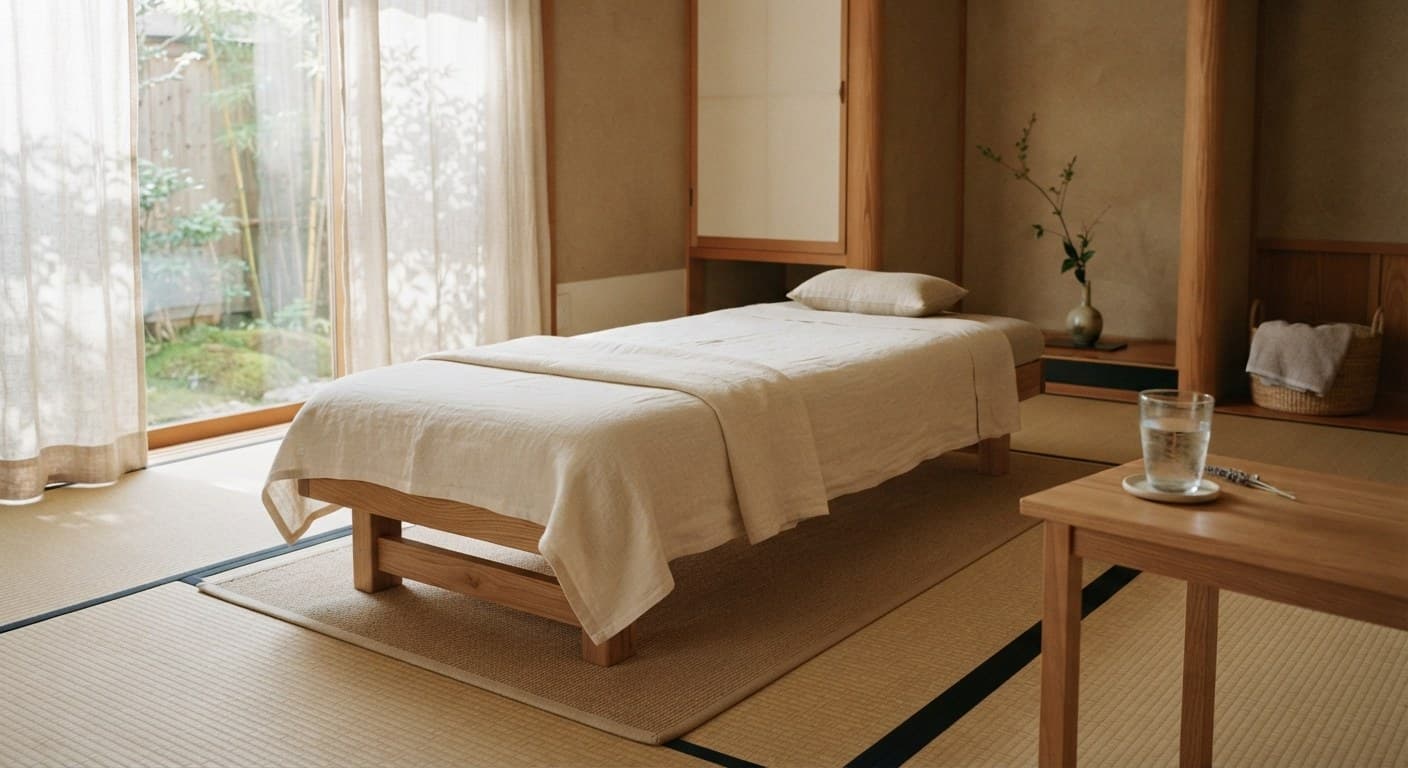
Most people who book a first session are not nervous about the Reiki. They are nervous about not knowing what they are supposed to do.
Do you undress? Do you talk? Are you meant to feel something, and does it mean the session failed if you do not? These are the questions that arrive in the first minute, and almost nobody asks them out loud.
So here is the whole thing, in order, including the parts I am careful never to promise.
Key Takeaways
- A first session asks nothing of you: you stay fully clothed, you are not required to breathe or visualise in any particular way, and there is no correct thing to feel.
- Feeling nothing at all is common at a first session and is not a sign that anything went wrong, which is why I say so before we begin rather than afterwards.
- What clients report and what research has demonstrated are two different registers. People describe feeling settled or sleeping better; the published evidence does not support claims about treating any health condition, and I do not make them.
Key Terms Explained
- 靈氣 (Reiki) / Universal Energy — The practice itself, passed down in the Usui lineage. The word is also used for the energy the practice works with.
- 手当て (Te-ate) / Placing the Hands — The ordinary Japanese word for care. Literally "putting the hand on," and it long predates Reiki as a word for looking after someone.
- 合掌 (Gasshō) / Palms Together — The gesture of placing the palms together at the chest, used to begin and end.
- 施術 (Sejutsu) / A Hands-On Session — The session itself, as distinct from training or attunement.
The Question Asked in the Doorway
Almost every first-time client asks me the same thing while they are still taking off their shoes: "What am I supposed to do?"
The honest answer is nothing. That is a difficult instruction for adults, particularly capable ones. People arrive expecting a task — a breathing pattern to follow, a visualisation to hold, an intention to set correctly. When I say there is nothing to get right, some look relieved and some look suspicious.
I understand the suspicion. I spent years as an engineer before I trained as a teacher, and I would have wanted a procedure too.
What Actually Happens, in Order
Before we begin
We talk for about ten minutes. I ask what brought you, whether anything hurts, and whether there is anywhere you would rather I did not place my hands. That last question matters more than the others, and I ask it directly rather than waiting for you to raise it.
You stay fully clothed. Take off your shoes, your watch, and anything tight. That is the extent of it.
I also tell people what I am not doing. I am not diagnosing anything, and I am not treating an illness. If you are unwell, that belongs with your doctor, and a session does not replace an appointment.
Related: What to Do When a Client Falls Asleep During Reiki explains this in detail.
During the session
You lie on your back, or sit in a chair if lying down is uncomfortable. There is a blanket, because people often feel cooler than they expect.
I begin with 合掌 (Gasshō), palms together, for a few seconds. Then I place my hands lightly on or just above the head, and move slowly through a sequence of positions — head, shoulders, torso, sometimes the feet. Each position lasts a few minutes. The touch is light and still; there is no pressing, no rubbing, and no manipulation of any kind.
A session runs about an hour. Nothing is said unless you want to talk. Most people stop talking within the first ten minutes without being asked to.
Related: Gassho and the Breath: The Two Things I Teach Before Any Hand Position explains this in detail.
Afterwards
I bring my hands away, close with 合掌 again, and let you sit up in your own time. Then water, and a few minutes of quiet before anyone tries to drive anywhere.
I ask what you noticed, not what you felt. The difference matters. "What did you feel?" is a question with an expected answer built into it, and people will find something to say in order to be polite.
Related: The Page I Send People To Says Reiki Does Not Work: Reading the NCCIH Summary Honestly explains this in detail.
What People Report, and What I Do Not Claim
The most common reports are ordinary ones. Warmth in the hands or the area being worked on. Heaviness, or the specific tiredness that arrives when you finally stop. Yawning, often a great deal of it. Some people fall asleep and are embarrassed about it, which is unnecessary.
A common misunderstanding is that the harder you concentrate, or the longer you sit, the more it works. In my experience it is the opposite. Relaxation matters most, and even a short session is enough.
Some people feel nothing at all. That happens frequently enough at a first session that I mention it before we start, so that it does not become evidence of failure halfway through.
Here is the part I am careful about. The United States National Center for Complementary and Integrative Health describes Reiki as an approach in which practitioners place their hands lightly on or just above a person. Its conclusion is plain: Reiki has not been clearly shown to be effective for any health-related purpose. It notes that most of the research has not been of high quality, that results have been inconsistent, and that no scientific evidence supports the existence of the energy field the practice describes. It also reports that Reiki has not been shown to have harmful effects.
I do not hide that paragraph from clients, and I do not argue with it. It is an accurate description of where the published evidence stands.
What I offer instead is narrower and, I think, more honest: an hour in which nothing is asked of you, and after which a good number of people say they feel settled, lighter, or that they slept better than usual. That is what I can describe. It is not a claim about illness, and I will not turn it into one.
What I Never Promise
I never promise a result. Not a specific one, not a general one, not by a particular date.
I never suggest stopping or changing medical treatment, and I would end a session with anyone who told me they had done so because of Reiki.
I never send distant Reiki to someone who has not asked for it, including when a well-meaning relative asks me to send it to another person. Consent is not a formality here. It is the practice.
People who do ask often tell me to send it "whenever is convenient," without setting a time. When I tell them afterwards the exact hour I did it, more than once they have said they suddenly felt lighter at that moment. I report those conversations as what they are — things clients have told me — and I leave them there. They are not evidence, and I do not present them as any.
And I never tell someone what they should have felt. If a client says the hour did nothing for them, that is information, not a failure of theirs.
FAQ
Q: Do I need to believe in Reiki for a session to be worth having? A: No, and I would be wary of anyone who tells you belief is required. Plenty of first-time clients arrive sceptical and stay sceptical afterwards while still describing the hour as restful. Belief is not an entry condition, and disbelief is not a barrier.
Q: What if I feel nothing at all? A: That is common at a first session and it is not a sign that anything went wrong. Some people notice warmth or heaviness immediately; others notice nothing during the hour and only register that they slept unusually well that night. Neither response tells you anything about you.
Q: Is Reiki a religion, or connected to spirits? A: No. It is not a religion, it has no doctrine, and it has nothing to do with ghosts or the occult. You are not asked to adopt any belief, and nothing is worshipped. It is a hands-on practice with a Japanese lineage, and that is the whole of it.
Key Insights to Remember
-
The instruction for a first session is genuinely "do nothing," and that is the part people find hardest. Adults arrive looking for a task to perform correctly, and the absence of one reads as missing information rather than as permission. If you spend the hour checking whether you are doing it right, you have given yourself a job.
-
What is reported after a session and what has been demonstrated in research are two different registers, and both deserve to be stated plainly. People describe feeling settled, lighter, or better rested; the published evidence does not support claims about treating any health condition. A practitioner who blurs those two things is doing you a disservice, whichever direction they blur them in.
-
Consent is the load-bearing part of the practice, not the paperwork around it. Asking where someone would rather not be touched, and refusing to send distant Reiki to a person who has not asked, are not extra courtesies added on top. Remove them and what is left is something other than what I was taught.
Sources
About the author

Japanese Reiki Shihan · traditional Usui Reiki, taught and certified in person
- ●Japanese Reiki Shihan (師範 / Reiki Master)
- ●Trained in the traditional Japanese Usui lineage
- ●20+ years of daily practice · teaches in person
- ●Former IT engineer & founder — grounded, no hype
I'm a Japanese Reiki Shihan who learned in the traditional Usui lineage and has practised every morning for over twenty years. My background is in IT and business, not the spiritual scene, so I write about Reiki plainly — what it is, how to practise it, and what it's honestly like — with no medical claims. Based in the Philippines, where I teach in person.
Enjoy this article?
Get honest, grounded writing on traditional Japanese Usui Reiki straight to your inbox.
Related Articles
What to Do When a Client Falls Asleep During Reiki
People fall asleep during Reiki often, and it is neither a problem nor proof that anything worked. Why it happens, and what to do.
8/18/2026

Practising Reiki on Family: Why It Is Harder
Giving Reiki to family is harder than to a client, and the difficulty is structural: no appointment, consent muddied by obligation.
8/17/2026

Keeping a Practice Journal: The Habit That Changed Me
I started a practice journal after giving a student a confident number I could not verify. The missed days proved most useful.
8/16/2026

Reiki for a Room, Not a Person: What I Do Not Claim
I practise Reiki in spaces and say so plainly, but I will not tell a client the room has changed. On the word joka.
8/15/2026
When a Client Becomes Emotional: Handling Tears
Why the instinct to ask a crying Reiki client if they are all right is the one a practitioner most needs to unlearn, and what steady hands offer instead.
8/13/2026

Practising When You Are Depleted: Honest Self-Care
Why a depleted week does not disqualify you from Reiki, how to shrink the routine without losing it, and where the honest line sits for giving sessions.
8/11/2026