Reiki for a Room, Not a Person: What I Do Not Claim
I practise Reiki in spaces and say so plainly, but I will not tell a client the room has changed. On the word joka.

Japanese Reiki Shihan (師範) · traditional Usui Reiki · 20+ years of daily practice
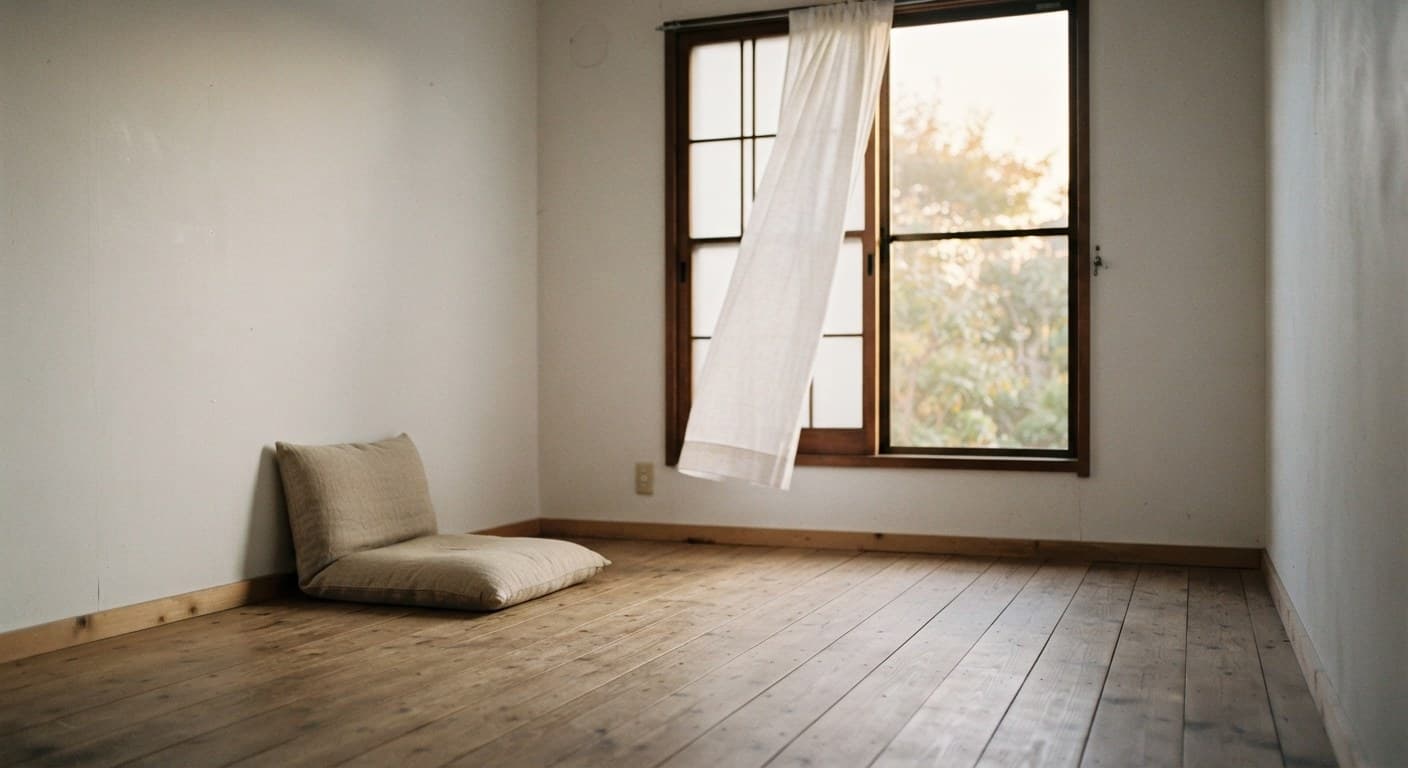
People ask me to do Reiki on rooms more often than you would expect. A new flat, an office where something went badly wrong, a house after a death. The request is always slightly apologetic, as though they know it sounds odd.
It does not sound odd to me. What I am careful about is the answer I give, because there is a version of this work that quietly stops being honest, and rooms are where it usually starts.
Key Takeaways
- I do practise Reiki in spaces, and I say so plainly. What I do not do is claim that the room changes, because I have no way to know that and no way to show it.
- Everything I can honestly describe about the practice sits on my side of the transaction: my attention, my state when I finish, and the fact that I have spent twenty minutes noticing a place instead of using it.
- The Five Precepts contain no claim about outcomes at all, which is why they survive this kind of scrutiny while mechanism talk does not.
Key Terms Explained
靈氣 (Reiki) / Universal Energy — the practice itself, and the word I use without attaching a mechanism to it.
手当て (Teate) / Hand Placement — laying hands on or just above something, which in a room means walls, corners, thresholds.
五戒 (Gokai) / The Five Precepts — Usui's daily principles, which make no promises about results and therefore cannot be falsified or oversold.
浄化 (Jōka) / Purification — the word most often used for space work, and the word I have grown most cautious about.
Related: An Engineer's Honest Take on Reiki: What I Am Willing to Claim, and What I Am Not explains this in detail.
The Flat Above the Restaurant
A student of mine once moved into a flat above a restaurant and asked me to come and do something about it.
She was specific about the problem. She could not sleep. The place felt wrong in a way she could not locate, and she had started avoiding the back bedroom without deciding to. She wanted the room cleared.
I went. I spent about forty minutes there. I sat in the back bedroom for a long time, walked the corners, put my hands near the window frame and the door, and did what I would do in a session with a person, except that nobody was lying down.
She slept properly that night and told me so the next day, and she was pleased, and I was pleased for her, and then I had to decide what to say about why.
Here is what I said. I told her that I did not know whether the room was different. I told her that what I could vouch for was that two people had now spent forty minutes paying deliberate attention to a space she had been avoiding, that the back bedroom had been entered on purpose rather than flinched away from, and that she had watched someone treat it as ordinary.
She asked whether that meant I thought it was psychological. I said I thought that was the wrong question, because it assumes the useful thing must be either the energy or the psychology, and I have no way to separate them and no need to.
What the Tradition Actually Contains
The tradition I was taught does include work on places and objects. This is not something modern practitioners invented for a market.
Usui Reiki as it was handed down includes practices directed at things other than bodies — at objects, at food and water, at rooms. Reiki is understood as something you connect with rather than something you generate, and once that is the frame, there is no particular reason it should stop at the boundary of a person.
So I have no interest in denying that the practice exists. What I notice is how quickly the language around it inflates.
The word usually used is 浄化, jōka, purification. It is a perfectly normal Japanese word and it is also doing an enormous amount of unearned work. Purification implies that something impure was present and is now gone. That is a claim about the room, with a before state and an after state, and I cannot demonstrate either one.
Compare that with what the tradition itself asks of a practitioner in the precepts. 今日だけは, just for today: do not anger, do not worry, be grateful, work diligently, be kind to others. There is not a single assertion about outcomes anywhere in it. Nothing in the Gokai says the anger will leave the room, or that the practitioner will succeed. It is a set of instructions about how to conduct yourself today.
Twenty-odd years of daily practice have left me with the view that this is not an accident. The parts of the tradition that make no outcome claims have travelled perfectly well for a century. The parts that make outcome claims are the parts that keep getting practitioners into trouble.
Related: When a Client Becomes Emotional: How I Handle Tears Without Overstepping explains this in detail.
What I Will and Will Not Say To a Client
I have a fairly short list, and I keep it short deliberately.
I will say that I practise Reiki in spaces and that I take the request seriously. I will say what I actually do, physically, so that nobody is paying for a mystery. I will say how long it takes and what it costs. I will say that many people describe a room as feeling easier afterwards, which is a statement about what people report and not a statement about the room.
I will not say that I have removed anything. I will not say that a space has been cleansed of a previous occupant, an argument, an illness or a death. I will not offer space work as a solution to a problem that has a practical cause, and I will ask about the practical causes first — damp, noise, light, a landlord dispute, a neighbour — because I have more than once found that the room felt wrong for reasons a builder could have addressed.
I will not do space work for a property sale where the claim is going to be passed on to a buyer. That one I decline outright. Whatever I think is happening, it is not something a third party should be paying for on the strength of my say-so.
And I will not use the word "cleansing" in writing, because it makes a promise I cannot keep.
Living outside Japan for a long time has made this discipline easier rather than harder. When you are the only person in the room from your tradition, overclaiming is expensive. People here have no cultural obligation to be polite about it, and I would rather be trusted on a small claim than doubted on a large one.
Related: The Page I Send People To Says Reiki Does Not Work: Reading the NCCIH Summary Honestly explains this in detail.
FAQ
Q: Do you believe the room actually changes? A: I do not know, and I have decided that not knowing is a reportable answer rather than a failure. What I believe, in a first-person sense, is that connecting with the energy of the universe has turned my own life in a better direction over twenty years. That belief is mine and I do not offer it as evidence for anyone else, and it certainly does not extend to a claim about someone's back bedroom.
Q: Is there any evidence for Reiki on spaces? A: None that I am aware of, and I would be sceptical of anyone who told you otherwise. The research literature on Reiki with people is itself weak, with small samples and inconsistent results, and the US National Center for Complementary and Integrative Health states plainly that Reiki has not been clearly shown to be effective for any health-related purpose. Space work has not been studied at all in any way I would cite.
Q: Then why do it? A: Because an undemonstrated mechanism is not the same as a worthless activity. Forty minutes of deliberate attention to a place someone has been avoiding is a reasonable thing to spend time on, whatever is or is not happening at the level of energy. I would rather describe that accurately and let the client decide than dress it up and be caught.
Q: What should I ask a practitioner who offers space clearing? A: Ask them what they will physically do, how long it takes, and what they claim will be different afterwards. The third answer is the one that matters. A practitioner who says "the space will be cleared of negative energy" is making a claim they cannot support. A practitioner who says "I cannot tell you the room will change, here is what I can tell you" is someone you can work with.
Key Insights to Remember
-
The claim is the thing to watch, not the practice. I can do exactly the same forty minutes in exactly the same room and be either honest or dishonest, and the difference is entirely in the sentence I say afterwards. Nothing about the work itself forces the sentence to inflate — that is a choice a practitioner makes, usually because the honest sentence sounds less impressive.
-
浄化 is a word worth resisting. Purification carries a hidden before-and-after that I cannot demonstrate in either direction. When I catch myself reaching for it, it is almost always because I want the session to sound like it accomplished something measurable, which is the exact impulse that separates a practitioner from an honest one.
-
The precepts are the safest part of the tradition because they promise nothing. Just for today: do not anger, do not worry, be grateful, work diligently, be kind. A century on, none of that has needed revision, while every confident claim about mechanism made in the same period has aged badly. That should tell practitioners something about where to put their weight.
Sources
About the author
Japanese Reiki Shihan · traditional Usui Reiki, taught and certified in person
- ●Japanese Reiki Shihan (師範 / Reiki Master)
- ●Trained in the traditional Japanese Usui lineage
- ●20+ years of daily practice · teaches in person
- ●Former IT engineer & founder — grounded, no hype
I'm a Japanese Reiki Shihan who learned in the traditional Usui lineage and has practised every morning for over twenty years. My background is in IT and business, not the spiritual scene, so I write about Reiki plainly — what it is, how to practise it, and what it's honestly like — with no medical claims. Based in the Philippines, where I teach in person.
Enjoy this article?
Get honest, grounded writing on traditional Japanese Usui Reiki straight to your inbox.
Related Articles
What to Do When a Client Falls Asleep During Reiki
People fall asleep during Reiki often, and it is neither a problem nor proof that anything worked. Why it happens, and what to do.
8/18/2026

Practising Reiki on Family: Why It Is Harder
Giving Reiki to family is harder than to a client, and the difficulty is structural: no appointment, consent muddied by obligation.
8/17/2026
Keeping a Practice Journal: The Habit That Changed Me
I started a practice journal after giving a student a confident number I could not verify. The missed days proved most useful.
8/16/2026
When a Client Becomes Emotional: Handling Tears
Why the instinct to ask a crying Reiki client if they are all right is the one a practitioner most needs to unlearn, and what steady hands offer instead.
8/13/2026
Your First Reiki Session, Step by Step
What actually happens in a first Reiki session — the consent question I ask first, why feeling nothing is normal, and the things I never promise.
8/12/2026

Practising When You Are Depleted: Honest Self-Care
Why a depleted week does not disqualify you from Reiki, how to shrink the routine without losing it, and where the honest line sits for giving sessions.
8/11/2026