What a Reiki Certificate Should and Shouldn't Mean
A Reiki certificate records that you received reiju in person — it never certifies healing power, and that honest distinction is the heart of the Usui path.

Japanese Reiki Shihan (師範) · traditional Usui Reiki · 20+ years of daily practice
Key Takeaways
| Point | In short |
|---|---|
| A certificate records reiju | It is a record of transmission, not a permit and not a promise of results |
| Each level carries its own paper | A stage you keep practising through, not a destination you arrive at |
| Paper cannot replace substance | Daily practice and a teacher you can reach matter most |
- A Reiki certificate documents that you received reiju (attunement) from a teacher in a lineage; it is a record of transmission, not a permit and not a promise of results.
- The three traditional levels of Usui Reiki each carry their own paper, and every one of them marks a stage you keep practising through, not a destination you arrive at.
- No certificate can stand in for the two things that actually carry the practice: daily practice and a real relationship with a teacher you can reach.
Key Terms Explained
| Term | Meaning in short |
|---|---|
| 靈氣 (Reiki) | Universal energy; not a religion, not the occult |
| 靈授 (Reiju) | The in-person attunement a certificate actually records |
| 師範 (Shihan) | The teacher level, authorised to give reiju |
| 五戒 (Gokai) | The Five Precepts, the ethical centre of the practice |
| 初伝・奥伝・秘伝 | The three traditional levels of Usui Reiki |
- 靈氣 (Reiki) / Universal Energy — connecting with the energy of the universe and letting it settle your life. Not a religion, and nothing to do with ghosts or the occult.
- 靈授 (Reiju) / Attunement, or Spiritual Blessing — the in-person transmission a teacher passes to a student. This is the event a certificate actually records.
- 師範 (Shihan) / Master Teacher — the level authorised to give reiju to others; roughly, "one qualified to be an example."
- 五戒 (Gokai) / The Five Precepts — Usui's daily principles for living, and the ethical centre of the whole practice.
- 初伝・奥伝・秘伝 (Shoden / Okuden / Shinpiden) / First, Inner, and Mystery Teachings — the three traditional levels of Usui Reiki Ryōhō.
The Two Weeks After My First Attunement
| Moment | What it showed |
|---|---|
| Receiving the Shoden certificate | The reiju was given, and the paper recorded it accurately |
| Two weeks of daily practice | Almost no dramatic sensation, no fireworks |
| The quiet beginning | The certificate was true because it claimed so little |
When I completed Shoden, my Level 1, I walked away with a certificate that said the reiju had been given. What I did not walk away with was any dramatic sensation.
 A certificate marks a beginning, not a finish line — mine simply recorded that the reiju had been given.
I kept the simple daily routine, about twenty minutes, for two weeks without missing a single day. And honestly, I did not feel much at first. I mention this plainly because so many introductions to Reiki promise instant heat or tingling the moment the attunement is done. For me, nothing dramatic happened in those early weeks — no rush, no fireworks, no proof I could point at.
The certificate on the shelf was accurate. It recorded that I had received the transmission and sat through the teaching. But it could not tell me whether the practice was "working," because that is not the kind of thing a piece of paper can hold. What the paper marked was a beginning, and the beginning felt quiet. Looking back, that quietness was the honest part. The certificate was true precisely because it claimed so little.
Related: How Long Does It Take to Become a Reiki Master? explains this in detail.
What the Paper Actually Records
| Element | What a certificate documents |
|---|---|
| Reiju | That an in-person transmission took place |
| The three levels | A stage of ongoing practice, not a finish line |
| In-person transmission | A real attunement, not a downloaded manual |
It helps to be exact about what a Reiki certificate is a record of. Once that is clear, most of the confusion around it falls away.
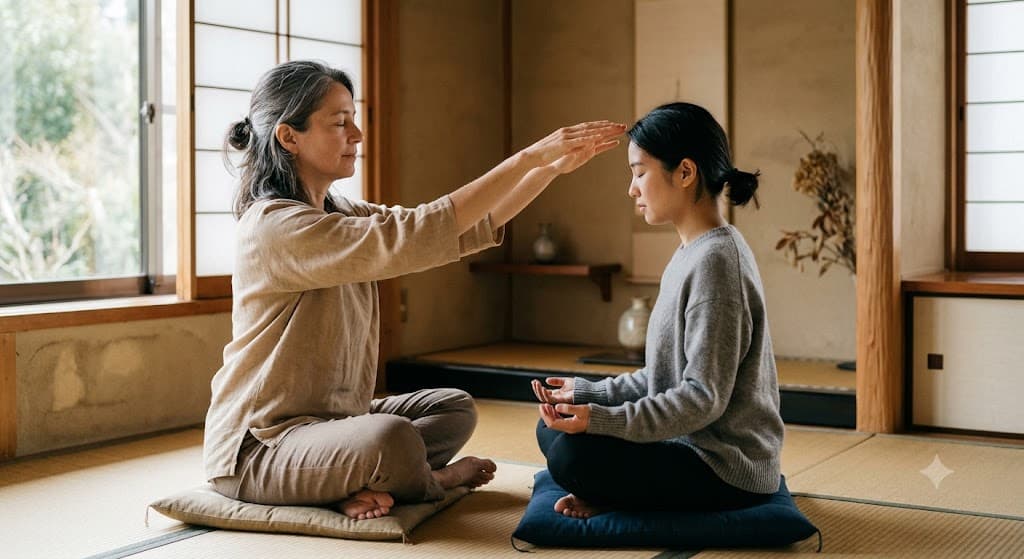 Reiju is passed directly, teacher to student, in the same room — the substance a certificate is meant to record.
Related: What Actually Happens in a Reiki Attunement (Reiju), and What Doesn't explains this in detail.
Reiju: the event a certificate marks
The heart of any Reiki level is the reiju — the attunement. Traditionally this is passed directly, teacher to student, in the same room. It is not information you download; it is something given in person. When a certificate is issued at the end of a course, what it honestly documents is that this transmission took place and that the student was taught the practices of that level. It says: this person sat with a teacher and received reiju. It does not say: this person now possesses a power.
The three levels: Shoden, Okuden, Shinpiden
Usui structured the teachings into three levels. Shoden (初伝), the first, is where you learn self-practice, the precepts, and the basics of working with others. Okuden (奥伝), the inner teachings, introduces the mantras and symbols and a way of sending Reiki at a distance. Shinpiden (秘伝), the mystery teachings, is the master level, where a student learns to give reiju and may step toward becoming a Shihan (師範), a teacher. Each level has its own certificate. None of them is a finish line. A certificate for Shoden is a note that you have started, nothing grander and nothing less.
Related: A New Survey Asks Who Actually Knows What Reiki Is — and the Honest Answer Is Uncomfortable for Everyone explains this in detail.
Why in-person still matters
A certificate is not the same as an attunement, and the symbols printed on one prove nothing about how they were received. Anyone can find images of them in a few seconds; what cannot be downloaded is the transmission itself. A photograph of a symbol is not reiju. A downloaded manual is not a teacher. This is the honest gap a certificate can hide: two documents can look identical while one sits on top of a real transmission and the other sits on top of a PDF. The paper is only ever as meaningful as what happened in the room.
Reading a Certificate Like an Engineer Reads a Spec
| Lens | The honest reading |
|---|---|
| A certificate as a record | Proof of completion, not of mastery or magic |
| What Reiki does | A settled, lighter feeling through gentle daily practice |
| What it does not do | No medical treatment, and no pressure to begin before your time |
I did not come to Reiki through the spiritual world, and I have spent a long working life in IT and, more recently, in AI. In that field I hold a stack of professional certifications. So I have a fairly unsentimental view of what any certificate is: a record that you completed a defined thing to a defined standard. It is genuinely useful. It is also routinely mistaken for something it is not — a certificate proves you finished a course, never that you are wise, gifted, or finished growing. I read a Reiki certificate the same way I read a technical spec: for what it actually asserts, not for what I wish it asserted.
 Neither the paper nor the effort is the point; the quiet, repeatable daily practice is.
This is also where I try to stay honest about Reiki itself. Reiki has no demonstrated specific medical effects, and there is no measured evidence for the energy field the practice describes. It also carries no known harm, and it is widely treated as a complementary approach for relaxation. That matches my own experience exactly. I would never tell you a certificate — or the practice behind it — treats an illness. What I can say plainly is that people, myself included, tend to feel settled and lighter, and that a short daily practice is often enough to notice it.
A common misunderstanding runs parallel to the certificate one: that the harder you concentrate, or the longer you sit, the more it works. In my experience it is the opposite. Relaxation matters most, and even a short session is enough — my own five honest minutes a morning are the proof. Neither the paper nor the effort is the point. The quiet, repeatable practice is. And if Reiki does not interest you right now, I take that to mean it is simply not your time yet. There is a right moment to learn anything, and I never push.
FAQ
Q: Does a Reiki certificate mean I can heal people?
A: No. It records that you received reiju in person and completed a level of study. Reiki is about relaxation and feeling settled, not medical treatment, and no certificate changes that. Think of the paper as a record of a beginning, not a permit to fix anyone.
Q: Is an online Reiki certificate the same as an in-person one?
A: They can look the same and mean different things. Traditionally reiju is passed directly from teacher to student in the same room, and that in-person transmission is the substance the certificate is meant to record. A certificate issued without an in-person attunement is documenting something else, so it is worth knowing exactly what a given course actually included.
Q: How long should it take to earn each certificate?
A: There is no fixed schedule that suits everyone. Reiki is a lifetime practice, and there is a right time to move between levels rather than a deadline. When your moment comes you will often find you have started before you even decided to, and there is no need to rush the paper.
Key Insights to Remember
- A certificate is honest when it claims little. Mine said the reiju had been given and the level had been taught — and that was all true, even though I felt almost nothing for the first two weeks. The value was never in the document; it was in the daily practice the document pointed toward.
- The room matters more than the paper. Because symbols and manuals now circulate freely, two identical-looking certificates can rest on very different foundations. What makes one meaningful is that a real teacher gave a real attunement in person, and that a student can still reach that teacher afterward.
- Treat the certificate the way a careful person treats any credential: as evidence of completion, not of mastery or magic. Reiki offers a settled, lighter feeling through gentle daily practice, not a cure for anything — and holding both of those truths at once is what keeps the tradition honest.
Sources & References
About the author

Japanese Reiki Shihan · traditional Usui Reiki, taught and certified in person
- ●Japanese Reiki Shihan (師範 / Reiki Master)
- ●Trained in the traditional Japanese Usui lineage
- ●20+ years of daily practice · teaches in person
- ●Former IT engineer & founder — grounded, no hype
I'm a Japanese Reiki Shihan who learned in the traditional Usui lineage and has practised every morning for over twenty years. My background is in IT and business, not the spiritual scene, so I write about Reiki plainly — what it is, how to practise it, and what it's honestly like — with no medical claims. Based in the Philippines, where I teach in person.
Enjoy this article?
Get honest, grounded writing on traditional Japanese Usui Reiki straight to your inbox.
Related Articles

Usui Reiki Level 2 (Okuden): What You Learn and When
Usui Reiki Level 2 (Okuden) from a Shihan: what you learn, the 21-day rule after Level 1, what the one-day class covers, and what it does not promise.
10/2/2026

Reiki Training in the Philippines: How to Choose a Course
Choosing Reiki training in the Philippines? Here are seven questions to ask before you book, how the levels are spaced, and what a Makati course involves.
9/24/2026
Usui Reiki Level 1 (Shoden): What the Course Actually Covers in One Day
Usui Reiki Level 1 (Shoden) is one in-person day: one attunement, a self-practice routine, and the Five Precepts. Here is what it covers and leaves out.
9/16/2026
The 21 Days After an Attunement: What I Ask Students
Why I give new Reiki students an instruction rather than an explanation for their first three weeks, and why I refuse to call any of it purification.
8/14/2026
The Questions I Ask Before Agreeing to Teach
A Japanese Reiki Shihan on the questions asked before accepting a student, and why 'not yet' is sometimes the kindest answer.
8/9/2026

What Reiki Should Cost: Pricing and Red Flags
There is no standard price for Reiki, which is what makes it hard to judge. Four pricing patterns worth walking away from.
8/5/2026