I Don't Feel Anything: Why That's Normal at First
After my first attunement I felt almost nothing for two whole weeks, and that is normal — here is what Reiki quietly does before you ever notice it.

Japanese Reiki Shihan (師範) · traditional Usui Reiki · 20+ years of daily practice
Key Takeaways
| Point | What it means for a beginner |
|---|---|
| Feeling nothing is normal | Early silence says nothing about whether the practice will settle into your life. |
| The expectation is the problem | Dramatic first-day accounts are memorable, which is exactly why they circulate. |
| Keep a record, not a score | Two lines a day gives you something to look back on that memory will not supply. |
- Most beginners feel little or nothing at first, and that has no bearing on whether the practice will settle into their life.
- Comparing yourself to other students' accounts is the fastest route to quitting, because you are comparing your inside to their summary.
- The question worth asking is not am I feeling it? but would I notice if this were working slowly?
Key Terms Explained
| Term | Reading | Meaning |
|---|---|---|
| 靈氣 | Reiki | Universal energy — connecting with it and letting it turn life in a better direction. |
| 霊授 | Reiju | Attunement — the transmission given in person by a teacher. |
| 五戒 | Gokai | The Five Precepts — Usui's daily principles. |
| 師範 | Shihan | Master teacher — qualified to teach and to give attunements. |
- 靈氣 (Reiki) / Universal Energy — connecting with the energy of the universe and letting it turn life in a better direction.
- 霊授 (Reiju) / Attunement — the transmission given in person by a teacher, which opens the student to the practice.
- 五戒 (Gokai) / The Five Precepts — Usui's daily principles, traditionally recited each morning and evening.
- 師範 (Shihan) / Master Teacher — the level at which one is qualified to teach and to give attunements.
Two Weeks of Nothing, Every Single Day
| Element | Detail |
|---|---|
| What I did | The simple daily routine after my Level 1 reiju, about twenty minutes |
| How long | Two weeks, without missing a day |
| What I felt | Not much at all — nothing dramatic |
| How I came to Reiki | Through a successful businessperson, not the spiritual world |
| What I did next | Kept going anyway |
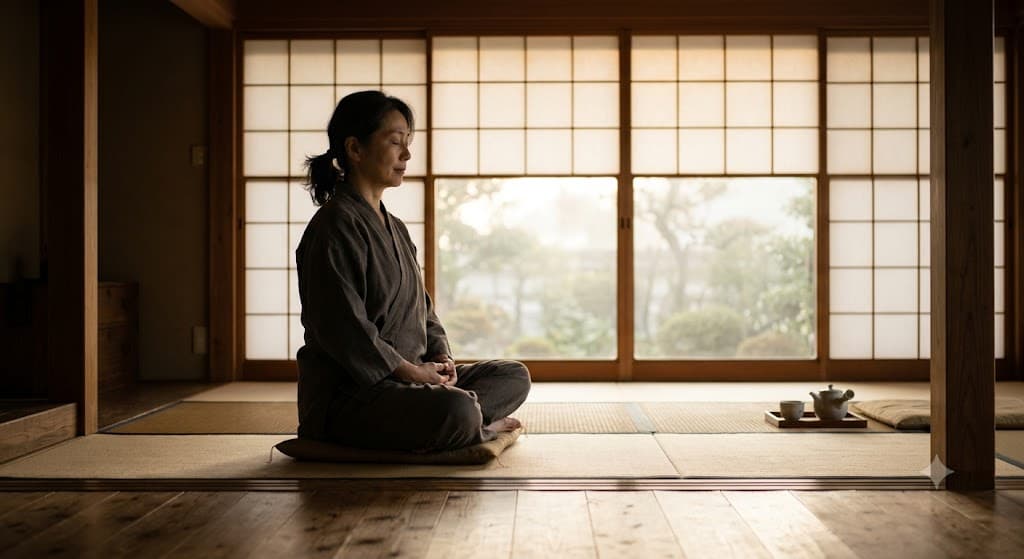
After my first attunement — the Level 1 reiju — I kept the simple daily routine, about twenty minutes, for two weeks without missing a single day.
 Two weeks of twenty quiet minutes a day, with nothing dramatic to show for it.
And honestly, I didn't feel much at all.
No fireworks. No confirmation. Just twenty quiet minutes a day and a small, nagging question: am I doing this wrong?
It's worth mentioning how I came to Reiki, because it shaped how I handled that silence. I didn't arrive through the spiritual world. The person who first told me about Reiki was already successful in business, getting real results in the real world — not a "spiritual" type at all. So when nothing happened, I didn't panic and I didn't conclude the whole thing was fake. I kept going, the way you'd keep going with any practice whose results you haven't seen yet.
More than twenty years later, that stretch of "nothing" is the part of my own story I tell students most often.
Related: My 5-Minute Morning Reiki Routine, After 20+ Years: Why It Got Shorter, Not Longer explains this in detail.
Where the Expectation of Instant Sensation Comes From
| Where you heard it | Why it sounds universal | What it actually is |
|---|---|---|
| Course descriptions | Written to make the first day sound worthwhile | The most vivid case, not the typical one |
| Other students | They report what stood out | Nobody recounts a session in which nothing happened |
| Online accounts | Strong experiences get written up | A record of the memorable, not the common |
This is the part I wish someone had explained to me in week one.
The belief that Reiki announces itself with heat in the palms is not something the tradition insists on. It is a by-product of how experiences get shared. A student who felt a sudden wave of warmth will describe it, and it will be remembered. A student who sat quietly and felt nothing has nothing to describe, so they say nothing at all — and the silent majority leaves no trace in the accounts you read.
The result is a picture assembled entirely from outliers. You then measure your own ordinary first week against it and conclude that something is wrong with you.
 The honest early markers are small — and for many people, in the first weeks, absent.
If I'm honest, the expectation of instant sensation is mostly a marketing problem, not a Reiki problem. Dramatic first-day experiences make better copy than "keep at it quietly for a while and see."
Related: Yawning and Shivers: The Body Signs You're Receiving Reiki explains this in detail.
Sensation Is Not the Measure
There is no rule saying you must feel heat. There is no threshold of sensation you have to cross to be "really" doing Reiki. The sensation is not the practice; the practice is the practice. After an attunement given properly, in person, what has been opened is not something you can verify by scanning your palms for warmth in week one.
What to Do Instead of Checking Your Palms
The problem with the silent weeks is not the silence. It is that you have nothing to hold on to, so the mind fills the gap by monitoring — which is the one thing guaranteed to make the practice harder.
Give it something else to do. Keep two lines a day.
| Line | What to write |
|---|---|
| 1 | Did I practise today, and roughly how long |
| 2 | One word for how the rest of the day went |
That is the whole record. No scoring, no ratings out of ten, no notes on sensation. Sensation is exactly what you are trying to stop watching.
The point of the record is not the writing; it is the reading, four to six weeks later. Memory is unreliable over that span and tends to flatten everything into "nothing has changed." Two lines a day will sometimes show you a pattern you had no idea was there — and just as often will show you nothing yet, which is also worth knowing rather than guessing at.
Related: What 1,284 Reiki Sessions Actually Show: An Honest Read of a New Study on the Subjective Experience explains this in detail.
The Small Signs That Do Show Up
There are markers. They're just humbler than people expect.
When I practise, I often shiver. And I almost always yawn. Over the years I've come to read the yawn as a sign that the energy is being received. It's small, physical, and repeatable, which is exactly why I point beginners toward it.
A yawn in the middle of a session is not boredom. It is very often the first thing a beginner actually registers. But its absence proves nothing either — I felt very little for two weeks and have practised daily for over twenty years since.
When to Actually Raise It With Your Teacher
There is a version of this worry that is worth bringing to a teacher, and a version that is not.
Not worth raising: I've been practising three weeks and felt nothing. That is the ordinary shape of a beginning, and a teacher will tell you so.
Worth raising: you find you are avoiding the practice and inventing reasons not to sit; you are ending sessions tenser than you began them; or you genuinely cannot remember what you were shown and are improvising. None of those are about sensation. All three are about the practice itself going off track, and all three are easily fixed in a short conversation.
The distinction matters because students who ask about sensation every week tend to feel embarrassed and eventually stop asking anything at all.
Why It Takes Time
Reiki isn't a switch. What changes is not usually the sensation in your hands — it's the direction your life is pointing. That takes months and years to see, not days. Which is frustrating to say and frustrating to hear, and it is still true.
The Engineer's Question: How Would I Even Know?
| Question I ask | My honest answer |
|---|---|
| What counts as evidence? | Not a tingle in week two — my life slowly turning for the better. |
| What are the limits of that evidence? | A life improving over twenty years is not a controlled experiment. |
| What does Reiki not do? | It is not medical care and it is not a religion. It makes no medical claims. |
| What does it do? | It may help things settle and feel lighter to carry. |
I spent a long career in IT and now work as an AI engineer, and that background makes me a difficult student of anything. My instinct is always to ask: what would count as evidence here, and what would I accept as a null result?
 The evidence, when it came, was slow and cumulative — nothing like what beginners are told to expect.
So let me answer that honestly.
What turned my half-belief into conviction was not a mystical experience. It was my life slowly turning for the better. Over the years I left a decade of salaried work, became independent in 2000, built businesses, published five books, and was even covered on Japanese television. I don't share that to boast — I share it because it is the actual evidence behind what I value. And notice what it isn't: it isn't a tingle in my palm during week two.
I should be equally honest about the limits of that evidence. A life improving over twenty years is not a controlled experiment. I can't hand you a clean causal chain. What I can tell you is what I observed in myself, and that the observation was slow, cumulative, and completely unlike the instant sensation that beginners are told to expect.
There's a related pattern I've come to trust. I often say I "became independent" in 2000, but the truth is I was let go from my company and had no choice but to strike out on my own. At the time it felt like the worst thing that had ever happened to me. Looking back, it was the best. When I moved to the Philippines, I arrived with no plan: no work, nothing to do, no one who needed me. More than ten years later I realised that the move was exactly what opened the biggest opportunities of my life. What looks like a setback is often setting something up — and "I don't feel anything yet" is a very small setback by comparison.
Reiki is not medical care and it is not a religion. It has nothing to do with ghosts or the occult. After more than twenty years of daily practice, here is what it is to me: connecting with the energy of the universe and letting it turn my life in a better direction. Nothing more mystical than that, and nothing less. It makes no medical claims of any kind. It may help things settle, feel lighter, feel less heavy to carry. That's the honest claim, and it's the only one I'll make.
And if none of this interests you right now — that's fine. It simply means it isn't your time yet. There's a right moment to learn anything, and when yours comes, you'll often find you had already started before you consciously decided to. I never push.
FAQ
Q: Everyone in my class described feeling something. Why didn't I?
A: Because the people who felt something are the ones who spoke. A room of ten students may contain six who felt nothing in particular, and none of them will volunteer that after hearing the first vivid account. You are comparing your inside with other people's summaries, which is not a fair comparison in either direction.
Q: Should I stop reading other people's accounts of their first sessions?
A: For the first couple of months, largely yes. Not because those accounts are dishonest, but because they are a collection of the most memorable experiences rather than the most common ones. Reading them daily while feeling nothing is a reliable way to talk yourself out of continuing.
Q: I felt something once and then nothing since. Have I gone backwards?
A: No. Sensation fluctuates with sleep, stress, temperature and how the day has gone, and a single vivid session does not establish a level you should then maintain. Treat the one experience as interesting rather than as a baseline you have now fallen below.
Q: Is there any point continuing if I never feel anything at all?
A: That is a fair question and deserves a straight answer: judge it on whether your life feels a little more settled over months, not on sensation at all. Some practitioners remain low on physical sensation permanently and get a great deal from the practice regardless. If, after several months, nothing anywhere has shifted, it may simply not be your time — and I would say so plainly rather than press you to continue.
Key Insights to Remember
- The silence of the first weeks is not a verdict. It is simply what the beginning of a long practice feels like, and treating it as failure is the most common reason people stop before anything has had a chance to settle. I felt almost nothing for two weeks and stayed with it anyway; that decision is the reason I'm still practising decades later.
- The expectation of instant sensation is assembled from outliers. The people who felt something dramatic are the ones who wrote it down, and the quiet majority left no record — so the picture you are measuring yourself against was never representative.
- Give the watching mind a job that isn't monitoring your palms. Two written lines a day, read back a month later, will tell you more about whether anything is changing than any amount of checking during the session ever will.
About the author

Japanese Reiki Shihan · traditional Usui Reiki, taught and certified in person
- ●Japanese Reiki Shihan (師範 / Reiki Master)
- ●Trained in the traditional Japanese Usui lineage
- ●20+ years of daily practice · teaches in person
- ●Former IT engineer & founder — grounded, no hype
I'm a Japanese Reiki Shihan who learned in the traditional Usui lineage and has practised every morning for over twenty years. My background is in IT and business, not the spiritual scene, so I write about Reiki plainly — what it is, how to practise it, and what it's honestly like — with no medical claims. Based in the Philippines, where I teach in person.
Enjoy this article?
Get honest, grounded writing on traditional Japanese Usui Reiki straight to your inbox.
Related Articles

An Engineer's Honest Take on Reiki
Two short lists: what I am willing to claim about Reiki after twenty years of daily practice, and what I refuse to say.
7/30/2026

Do You Have to 'Believe' in Reiki for It to Work?
No, you do not have to believe in Reiki for a session to be worth doing. How openness differs from faith, and the placebo question.
7/28/2026

Reiki Has Nothing to Do With Ghosts or the Occult
Why Reiki has nothing to do with ghosts, spirits, or the occult — where the confusion comes from, and what the practice is.
7/27/2026
Is Reiki a Religion? No — Here's What It Actually Is
Reiki is not a religion — it has no deity, doctrine, or worship. What it actually is, and why it sits beside any faith.
7/25/2026
Who Was Mikao Usui? Reiki's Founder Beyond the Legends
Mikao Usui was a Japanese seeker who framed Reiki as connecting with universal energy, and much of the legend around him was added long after his death.
7/1/2026