How to Tell If Your Pet Is Open to Reiki
Animals answer with their bodies: approaching and settling mean yes, walking away means not now. Reading consent honestly.

Japanese Reiki Shihan (師範) · traditional Usui Reiki · 20+ years of daily practice
Key Takeaways
- Animals show you, through plain body language, whether they want to stay near a Reiki session or not — approaching, settling, and relaxing are welcome signs; leaving is an answer too, and it deserves respect.
- Consent works on two levels with pets: the owner asks for the session, and the animal decides moment by moment whether to receive it. Both levels matter, and neither can be skipped.
- You do not need to interpret anything mystical. Watching a pet honestly — without projecting the result you hope for — is the entire skill, and it is one anyone can learn.
Key Terms Explained
- 靈氣 (Reiki) / Universal Energy — the practice of connecting with universal energy and letting it flow through the hands.
- 師範 (Shihan) / Master Teacher — a teacher in the traditional lineage authorized to teach and attune others.
- 遠隔 (Enkaku) / Distant Healing — Reiki sent at a distance, only ever when it has been requested.
The Question That Brings People to My Door
Of all the reasons people first come to me to learn Reiki, one of the loveliest is a pet. Someone has a dog getting older, or a cat who gets anxious when the household changes, and they ask: could I learn to do something gentle for this animal I love? I always tell them the same two things. Yes, Reiki can be given to animals — dogs and cats included. And I only ever work with an animal at the owner's request, with their clear permission.
The question that follows is the one this article is about: "But how do I know if my pet actually wants it?" It is an excellent question, and the fact that someone asks it at all tells me they will be good at this. The honest answer is that your pet will tell you — not in words, but in behavior that is surprisingly easy to read once you decide to read it honestly.
Related: Reiki for Dogs and Cats: A Gentle, Consent-First Guide explains this in detail.
What Openness Looks Like — and What "No" Looks Like
The welcome signs
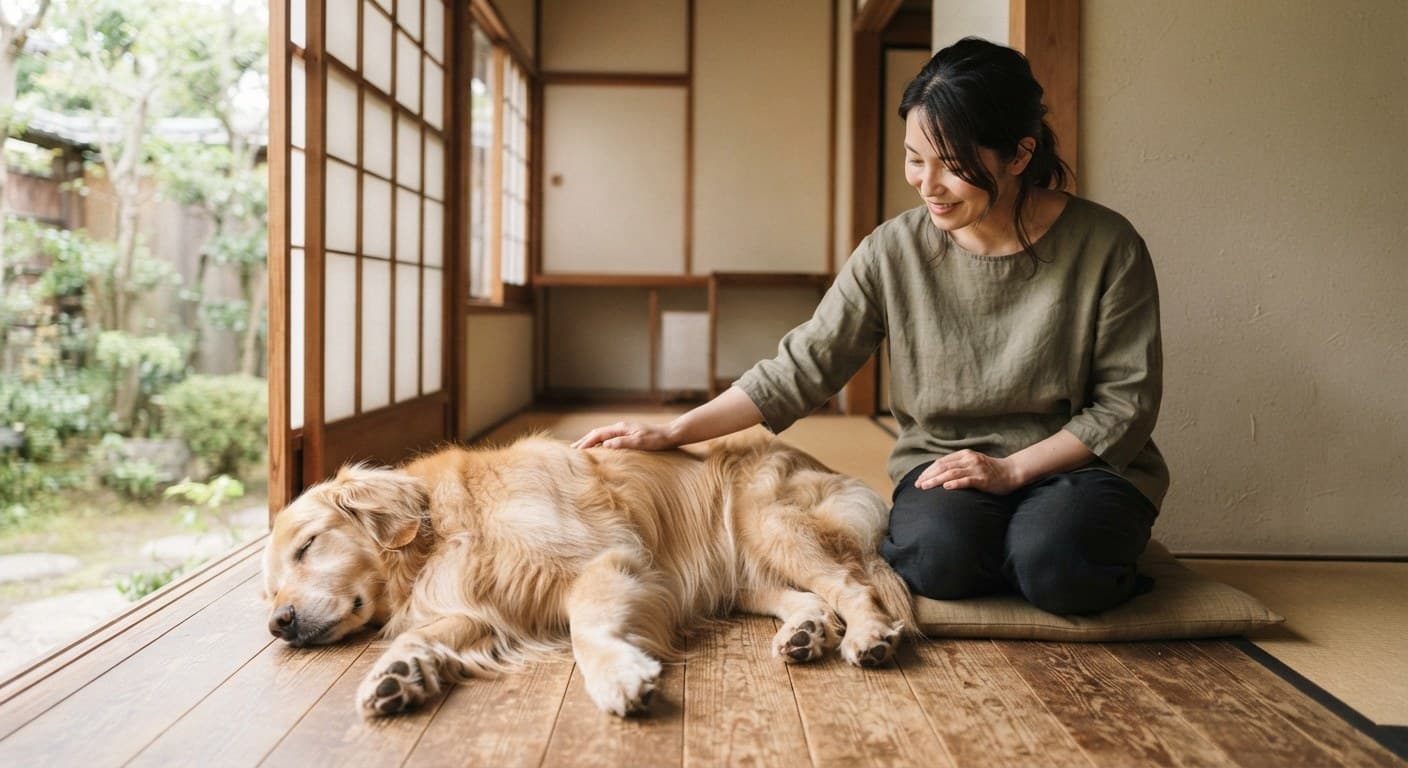
An animal that is open to Reiki tends to make it obvious. The dog wanders over and lies down against your leg. The cat, who normally keeps a polite distance, curls up within reach and stays. As a session goes on, you may see the body soften: a long exhale, a sigh, the head lowering, sometimes a deep sleep that lasts after your hands come away. None of this needs interpreting. Settling, staying, softening — these are the signs.
Related: Reiki for Shelter Cats: What the Forbes Story Shows explains this in detail.
The equally clear "not now"
The other answer is just as readable. The animal gets up and leaves. It repositions so your hands are not where you placed them. It stays alert, ears working, body tense, watching the room rather than resting. Any of these means "not now," and the right response is simply to stop. Not to follow the animal across the room, not to hold it in place — to stop. With animals, as with people, Reiki that is imposed is not Reiki at its best. I never send distant Reiki to a person who has not asked for it, even when I would love to help; the same restraint applies to a cat who has voted with her feet.
Keep sessions short and let the animal set the clock
Animals rarely want long sessions. A few minutes is often enough, and the animal will end it precisely when it is done — by standing up and walking away, with no social politeness about it. I find this refreshing. Humans sometimes endure a session to be courteous. A cat never will.
Related: How Distant Reiki Works — and Why I Never Send It Uninvited explains this in detail.
An Engineer's Note on Not Fooling Yourself
I spent decades in IT before I became a Shihan, and that background left me with a habit I consider healthy: distrust your own wishful thinking. When you love an animal and want Reiki to be welcome, it is tempting to read every blink as bliss. So watch like an engineer reads a log file — record what actually happened, not what you hoped. Did the dog stay or leave? Did the body soften or stay braced? Would this animal normally nap at this hour anyway?
Being honest about that last question matters. A cat that sleeps eighteen hours a day sleeping near you is weak evidence of anything. A skittish rescue dog choosing, repeatedly, to lie down under your hands — that is a pattern worth noticing. I make no medical claims for Reiki with animals, just as I make none for people. What I can say is what owners report and what I observe: animals that are open to it tend to look deeply settled, and they come back for more of it on their own initiative. That, read plainly and without projection, is all the confirmation the practice needs.
FAQ
Q: Do I need my pet's "permission" if it's my own animal? A: You have the owner's side of consent covered, but the animal still gets its say — behaviorally. Offer, observe, and let the animal approach, stay, or leave. Treating that choice as real is what keeps the practice gentle.
Q: What if my pet walks away every time? A: Then the answer is "not now," and that is fine. Try again another day, in a calmer moment, or simply practice on yourself in the same room. Some animals grow curious after watching from a distance for a while; some never do, and nothing is wrong.
Q: Can Reiki replace veterinary care for a sick pet? A: No. Reiki is not medical care and does not treat or cure illness in animals any more than in people. A sick animal needs a veterinarian. Reiki can sit alongside that care as something gentle the animal may find settling — never instead of it.
Key Insights to Remember
- The skill of animal Reiki is mostly the skill of honest observation. Animals cannot be talked into a placebo story and cannot be polite about a session they dislike, so their behavior is unusually trustworthy feedback — if you resist the urge to project.
- Consent is not a formality to get past; it is the practice itself. Asking the owner, offering rather than imposing, and accepting a walk-away as a complete answer all train the same restraint that distant Reiki demands.
- "Not now" is not failure. An animal that declines today has still taught you to offer without needing to be accepted — and in the traditional practice, that lightness of grip is precisely what you are there to learn.
Sources
About the author

Japanese Reiki Shihan · traditional Usui Reiki, taught and certified in person
- ●Japanese Reiki Shihan (師範 / Reiki Master)
- ●Trained in the traditional Japanese Usui lineage
- ●20+ years of daily practice · teaches in person
- ●Former IT engineer & founder — grounded, no hype
I'm a Japanese Reiki Shihan who learned in the traditional Usui lineage and has practised every morning for over twenty years. My background is in IT and business, not the spiritual scene, so I write about Reiki plainly — what it is, how to practise it, and what it's honestly like — with no medical claims. Based in the Philippines, where I teach in person.
Enjoy this article?
Get honest, grounded writing on traditional Japanese Usui Reiki straight to your inbox.
Related Articles

Reiki for Dogs and Cats: A Gentle, Consent-First Guide
A consent-first guide to Reiki with dogs and cats: the double consent rule, what a session looks like, and where the vet comes first.
7/20/2026

Reiki Training in the Philippines: How to Choose a Course
Choosing Reiki training in the Philippines? Here are seven questions to ask before you book, how the levels are spaced, and what a Makati course involves.
9/24/2026

Usui Reiki Level 1 (Shoden): What the Course Actually Covers in One Day
Usui Reiki Level 1 (Shoden) is one in-person day: one attunement, a self-practice routine, and the Five Precepts. Here is what it covers and leaves out.
9/16/2026

A Reiki Trial That Included a Sham Group
A 2026 trial compared Reiki against sham Reiki in 60 ventilated ICU patients. An honest reading of what the results support.
8/18/2026

What to Do When a Client Falls Asleep During Reiki
People fall asleep during Reiki often, and it is neither a problem nor proof that anything worked. Why it happens, and what to do.
8/18/2026

Why Most Reiki Studies Cannot Be Compared With Each Other
People ask what the research says as though the studies can be added together. Four ordinary differences block comparison.
8/17/2026