Who Was Mikao Usui? Reiki's Founder Beyond the Legends
Mikao Usui was a Japanese seeker who framed Reiki as connecting with universal energy, and much of the legend around him was added long after his death.

Japanese Reiki Shihan (師範) · traditional Usui Reiki · 20+ years of daily practice
Key Takeaways
- Usui's own teaching centred on daily self-cultivation and the Five Precepts, with hands-on work as one part of the whole rather than the main event.
- The "Reiki" brand name, the fixed hand positions, and much of the mythology took shape after Usui, largely as the practice travelled to the West.
- In Usui's own framing, Reiki is simply connecting with universal energy to help life feel more settled — it is not a religion, and it is not medical care.
Key Terms Explained
靈氣 (Reiki) / Universal Energy — connecting with the energy of the universe; also the modern name for the whole practice. 五戒 (Gokai) / The Five Precepts — Usui's short set of daily principles for how to live. 靈授 (Reiju) / Attunement — the in-person transmission a teacher gives to open a student to the practice. 手当て (Teate) / Hands-on Healing — the older Japanese term for laying hands on someone to help them feel calmer.
Meeting Reiki Through a Businessman, Not a Guru
| Point | In short |
|---|---|
| How I met Reiki | Through a successful businessperson, not the spiritual scene |
| First impression | Practical and grounded, not mystical |
| Why it matters here | The real Usui fits that same down-to-earth picture |
I did not come to Reiki through the spiritual world. The person who first told me about it was someone already successful in business, getting real results in the real world — not a "spiritual" type at all. That detail has stayed with me for more than twenty years, because it quietly disproved everything I expected. My very first impression of Reiki had nothing to do with the mystical image most people carry.
 Reiki reached me through an ordinary, practical person — not the mystical scene most people imagine.
I mention this at the start of an article about Mikao Usui on purpose. When people ask "Who was Usui?", they often want a mystic, a hermit, a man struck by lightning on a mountain. The real answer is closer to the businessman who introduced me: a curious, practical person, living in an ordinary time, looking for something that worked. Reading the records of Usui's life, I recognise that same grounded quality — and I think it matters far more than the legend that grew on top of it.
Related: Reiki's Round Trip: How a Japanese Practice Left Home and Came Back Through the West explains this in detail.
The Man the Records Describe
| Milestone | What the records show |
|---|---|
| Birth | 15 August 1865, Taniai village, Gifu Prefecture |
| Mount Kurama | A 21-day retreat in spring 1922, one turning point among years of study |
| The Gakkai | Founded in Tokyo in April 1922 to teach and offer sessions |
| The name "Reiki" | Fixed as a system name mainly after the practice reached the West |
| What he left | The Five Precepts and the reiju attunement |
From Gifu to Mount Kurama
 Mount Kurama, where Usui's 1922 retreat became one turning point in years of study.
Mikao Usui was born on 15 August 1865, in the village of Taniai in the Yamagata district of Gifu Prefecture, Japan. His family is traced to samurai ancestry connected to the Chiba clan, and he received a broad education. Across his life he studied history, medicine, Buddhism, Christian scripture, psychology and Taoism — a wide, restless curiosity rather than a single narrow path.
The most famous scene in his story is a retreat on Mount Kurama, a sacred mountain north of Kyoto, where in the spring of 1922 he undertook a twenty-one-day practice of prayer and fasting. Tradition says his understanding of Reiki crystallised there. What the honest historian notices, though, is that his teaching did not spring from nothing in that one moment. He had been studying, practising and reflecting for years before Kurama. The mountain was a turning point, not a magic trick.
Related: Traditional Japanese vs Western Reiki: 7 Differences That Actually Matter explains this in detail.
The Gakkai, the Earthquake, and How the Name Travelled
In April 1922 Usui settled in the Harajuku area of Tokyo and founded the Usui Reiki Ryōhō Gakkai, a society for teaching his method and offering sessions. His rooms filled with visitors. When the Great Kantō Earthquake struck Tokyo in September 1923, he went out into the streets to offer 手当て (Teate) / Hands-on Healing and comfort to the injured and grieving — the act that spread his name most widely in his own lifetime.
One point surprises many students: in Usui's day, what he taught was not commonly called "Reiki" as a brand at all. It went by names like the way of Usui and Usui teate — hands-on work. The word reiki existed in its plain sense of spiritual energy, but it became the name of a system mainly once the practice reached the West. Fixed hand positions and much of the later structure were added by students such as Chujiro Hayashi, and then by Hawayo Takata, who carried it abroad. Takata is also thought to have folded in Christian-sounding framing to make it feel less foreign to Western audiences — including the persistent story that Usui held a doctorate from an American university, which the records do not support.
Related: Lili Reinhart, Reiki Master: A Careful Reading explains this in detail.
Reiju and the Five Precepts: What He Actually Passed On
Strip away the embellishment and two solid things remain. The first is 靈授 (Reiju) / Attunement, the in-person transmission that Usui used to reconnect a student with the energy. This is what set his approach apart from ordinary hands-on healing of the time. The second is the 五戒 (Gokai) / The Five Precepts: just for today, do not be angry, do not worry, be grateful, work honestly, and be kind to others. Usui asked students to recite them morning and evening. They were his own wording of older principles, and he treated them as the very hub of the practice — as much of the path lived in the precepts as in any energy work.
Usui died on 9 March 1926 of a stroke while travelling to teach, and his grave stands at Saihōji Temple in Tokyo. The memorial stone raised the following year records that he taught Reiki to over two thousand people. That is the shape of the man: a teacher, not a wizard.
What a Former Engineer Reads Into the Usui Story
| Lens | What it reveals |
|---|---|
| Remove the marketing | A simple, workable method remains |
| Symbols online | Images are data; reiju is transmission |
| After 20+ years | Reiki is connecting with energy to let life settle |
Before this life I spent decades in IT — server administration, building, running businesses. An engineer's habit is to ask what actually holds up when you remove the marketing. Applied to Usui, that habit is clarifying rather than cynical. The dramatic claims fall away, and a workable method is left standing.
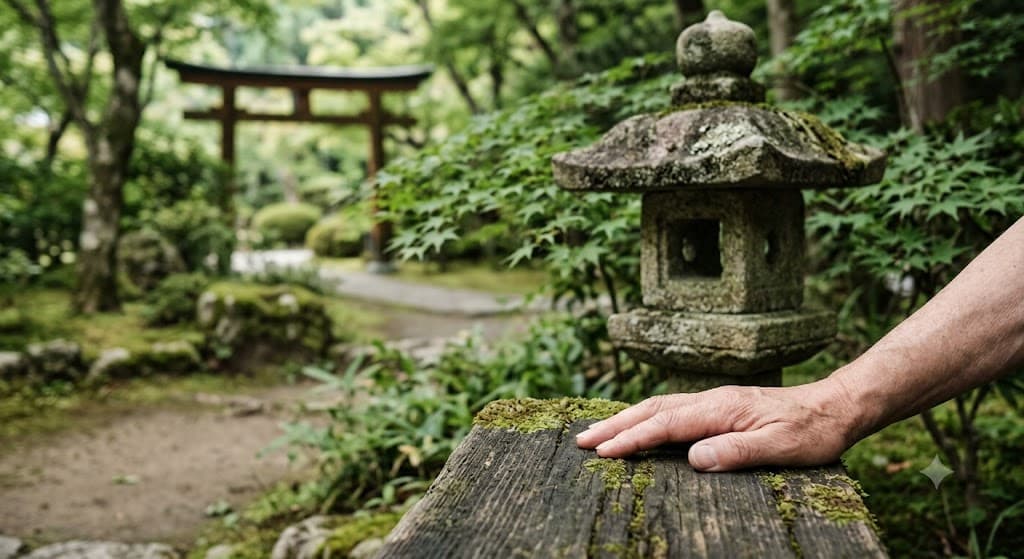
 The Five Precepts, recited morning and evening, sit at the quiet centre of what Usui passed on.
I notice, for example, that the Reiki symbols were traditionally meant to be kept private, passed only through attunement. These days a quick search turns up plenty of images — which is exactly why receiving them properly, in person, still matters. A photograph of a symbol is data; reiju is transmission. That distinction is the whole reason a living lineage back to Usui means something, and why I teach face to face.
The other thing I read into his story is how ordinary its foundation is. After more than twenty years of daily practice, here is what Reiki is to me: connecting with the energy of the universe and letting it turn life in a better direction — nothing more mystical than that, and nothing less. Usui was not building a religion, and his method has nothing to do with ghosts or the occult. He was offering a way to feel settled and to live with a little more kindness. If that interests you, good. If it does not speak to you right now, that is completely fine — there is a right time for everything, and I never push.
FAQ
Q: Did Mikao Usui invent Reiki, or discover it?
A: A bit of both, honestly. He drew on Buddhist precepts, hands-on practices already common in Japan, and his own study, then shaped them into a teachable method with attunement at its centre. Calling it a "discovery of ancient energy" overstates it; calling it his own synthesis is fair.
Q: Is it true he had a doctorate from an American university?
A: No. That claim appears in Western retellings but is not supported by the records. It seems to have been added later to make Reiki feel more familiar to Western audiences.
Q: Was Usui starting a religion?
A: He was not. His precepts drew on Buddhist and other sources, but he framed the practice as open to anyone, regardless of faith. It is a way of connecting with energy to help life feel calmer, not a belief system to convert to.
Key Insights to Remember
- The legend and the man are two different things. The mountain, the lightning, the foreign doctorate make a good story, but Usui's real life was study, service and a quiet daily practice. Knowing the difference protects you from hype and lets you meet the practice as it actually is.
- What survived Usui is a method, not magic. The Five Precepts and the reiju attunement are simple, repeatable and still taught the same way. That durability is the real evidence of value — far more than any dramatic origin scene.
- The precepts are the quiet centre. Usui treated "just for today, be kind, be grateful" as the heart of everything, equal to the energy work itself. If you only ever took the precepts from his story, you would already be living most of what he taught.
Sources & References
- Mikao Usui — Wikipedia
- Usui, Mikao (1865–1926) — Encyclopedia.com
- Mikao Usui — EBSCO Research Starters
- Usui Mikao — International House of Reiki
- What Is the History of Reiki? (Usui Memorial translation) — The International Center for Reiki Training
- Reiki — U.S. National Center for Complementary and Integrative Health (NCCIH)
About the author
Japanese Reiki Shihan · traditional Usui Reiki, taught and certified in person
- ●Japanese Reiki Shihan (師範 / Reiki Master)
- ●Trained in the traditional Japanese Usui lineage
- ●20+ years of daily practice · teaches in person
- ●Former IT engineer & founder — grounded, no hype
I'm a Japanese Reiki Shihan who learned in the traditional Usui lineage and has practised every morning for over twenty years. My background is in IT and business, not the spiritual scene, so I write about Reiki plainly — what it is, how to practise it, and what it's honestly like — with no medical claims. Based in the Philippines, where I teach in person.
Enjoy this article?
Get honest, grounded writing on traditional Japanese Usui Reiki straight to your inbox.
Related Articles

An Engineer's Honest Take on Reiki
Two short lists: what I am willing to claim about Reiki after twenty years of daily practice, and what I refuse to say.
7/30/2026
Do You Have to 'Believe' in Reiki for It to Work?
No, you do not have to believe in Reiki for a session to be worth doing. How openness differs from faith, and the placebo question.
7/28/2026

Reiki Has Nothing to Do With Ghosts or the Occult
Why Reiki has nothing to do with ghosts, spirits, or the occult — where the confusion comes from, and what the practice is.
7/27/2026
Is Reiki a Religion? No — Here's What It Actually Is
Reiki is not a religion — it has no deity, doctrine, or worship. What it actually is, and why it sits beside any faith.
7/25/2026
I Don't Feel Anything: Why That's Normal at First
After my first attunement I felt almost nothing for two whole weeks, and that is normal — here is what Reiki quietly does before you ever notice it.
7/12/2026