Japanese vs Western Reiki: 7 Differences That Matter
Traditional Japanese and Western Reiki share one founder but differ in reiju, the Five Precepts, and intuition over fixed hand positions — not in raw power.

Japanese Reiki Shihan (師範) · traditional Usui Reiki · 20+ years of daily practice
| Question | Short answer |
|---|---|
| Same source? | Yes — both branches descend from Mikao Usui |
| Where they split | Reiki travelling west with Takata, late 1930s |
| What really differs | Emphasis and manner, not power |
Most of the "Japanese vs Western" comparisons online read like a contest, as though one lineage holds a secret the other lost. After more than twenty years of daily practice, and years of teaching in the Usui lineage from where I live in the Philippines, I have come to see it differently. Both branches grow from the same root. The differences are real, but they are differences of emphasis and manner, not of power. This article walks through the seven that I think are worth understanding before you choose a class or a teacher.
Key Takeaways
| Theme | Takeaway |
|---|---|
| Shared root | One founder; the split began around 1938 |
| Real differences | The empowerment, hand placement, and the precepts |
| What matters most | The teacher in front of you, not the label |
- Both styles descend from Mikao Usui; the split began when Reiki travelled west with Hawayo Takata around 1938, and the two branches then developed in near isolation for decades.
- The clearest real differences are the empowerment (reiju versus a structured attunement), hand placement (intuition versus fixed positions), and how central the Five Precepts are treated.
- The label "Japanese" or "Western" matters far less than the teacher in front of you, since most teachers today quietly blend both.
Key Terms Explained
| Term | Meaning |
|---|---|
| 靈氣 (Reiki) | Universal energy |
| 霊授 (Reiju) | Repeated empowerment or blessing |
| 五戒 (Gokai) | The Five Precepts |
| 霊示法 (Reiji-hō) | Intuitive hand guidance |
| 病腺 (Byōsen) | The felt sense of gathered energy |
- 靈氣 (Reiki) / Universal Energy — the practice of connecting with the energy of the universe and letting it help daily life settle in a better direction.
- 霊授 (Reiju) / Spiritual Blessing — the simple empowerment a teacher offers a student, traditionally repeated many times rather than given once.
- 五戒 (Gokai) / The Five Precepts — Usui's short daily principles for living: for today, do not anger, do not worry, be grateful, work honestly, be kind to others.
- 霊示法 (Reiji-hō) / Intuitive Hand Guidance — letting the hands be led to where they settle, rather than following a memorised sequence.
- 病腺 (Byōsen) / Felt Sense of Gathered Energy — the sensation, in the practitioner's hands, of where energy seems to gather during a session.
My First Reiju, and Two Weeks of Feeling Almost Nothing
| Moment | What happened |
|---|---|
| First reiju (Level 1) | Kept a roughly twenty-minute daily routine for two weeks |
| Early sensations | Felt little; no instant heat or tingling |
| How I came to it | Through a businessperson, not the spiritual scene |
After my first attunement, the Level 1 reiju, I kept a simple daily routine of about twenty minutes for two weeks without missing a day. Honestly, I did not feel much at first. I say this plainly because so many introductions promise instant heat or tingling, and mine did not arrive on schedule. For me, nothing dramatic happened in those early weeks.
 My early practice was quiet — about twenty minutes a day, with little to feel at first.
I did not come to Reiki through the spiritual world, either. The person who first told me about it was someone already successful in business, getting real results in the ordinary world, not a "spiritual" type at all. That mattered: my very first impression of Reiki had nothing to do with the mystical image most people expect. So when the sensations were quiet at the start, I did not panic or assume I was doing it wrong. I simply kept going. That patience, more than any single technique, is the thing the traditional Japanese approach asks of you.
Related: Reiki's Round Trip: How a Japanese Practice Left Home and Came Back Through the West explains this in detail.
The Seven Differences, One by One
| # | Japanese tradition | Western style |
|---|---|---|
| 1 | Repeated reiju | Structured attunement |
| 2 | Intuitive hand guidance | Fixed hand positions |
| 3 | Precepts at the centre | Precepts as an add-on |
| 4 | Path of self-cultivation | Hands-on service |
| 5 | Many small empowerments | One attunement per level |
| 6 | Symbols kept private | Symbols taught more openly |
| 7 | Went quiet at home after the war | Spread across the world |
The two branches parted ways for a very human reason. Usui taught in Japan in the early 1920s, and the Tokyo society formed around his teaching, the Usui Reiki Ryōhō Gakkai, carried it forward there. Takata learned from Usui's student Chūjirō Hayashi and brought the practice to Hawaii and then the American mainland, where she shaped it for the audience in front of her. After the Second World War the Gakkai in Japan largely went underground, so for decades the Western branch was the one most of the world could actually find. When the two reconnected, the contrasts below were what stood out.
 The two branches grew from the same root but developed a different emphasis and manner.
Related: Hand Positions for Self-Reiki: A Beginner's Map, Not a Rulebook explains this in detail.
1. The empowerment: reiju versus attunement
In the Japanese tradition the empowerment is called 霊授 (Reiju), a plain, repeatable blessing. Usui's students received it again and again at their regular meetings to keep deepening their connection. The Western branch formalised this into the attunement, a more structured, symbol-centred ritual usually given once per level. Same purpose, different shape: one is quiet repetition, the other a defined ceremony.
2. Hand placement: intuition versus fixed positions
Traditional practice leans on 霊示法 (Reiji-hō), letting the hands be guided to where they naturally rest, along with 病腺 (Byōsen), the felt sense of where energy seems to gather. Takata simplified this into a set of standardised hand positions, a reliable head-to-toe sequence anyone could follow. The fixed positions are easier to teach; the intuitive approach asks you to trust what your own hands notice.
Related: Lili Reinhart, Reiki Master: A Careful Reading explains this in detail.
3. The heart of it: the Five Precepts
In Japan the 五戒 (Gokai) sit at the centre, not the edges. Students recited them morning and evening, and it was said that as much growth came from living the precepts as from any energy work. Much of the Western teaching, understandably focused on hands-on sessions, has treated the precepts as a gentle add-on. To me this is the difference that matters most, because the precepts are where Reiki actually touches how you live.
4. The goal: self-cultivation versus a service
Usui's system was, first, a path of self-cultivation — an art of steadying your own mind and life. Carried west, Reiki was often reframed as a hands-on service you receive from a practitioner. Neither framing is wrong, but they point in slightly different directions: one asks what Reiki does for others through you, the other asks what daily practice does within you.
5. Repetition versus a single attunement
Because the Japanese approach used repeated reiju, the connection was understood to strengthen gradually over time, like tending a fire rather than lighting it once. The Western three-level structure tends to give one attunement per degree and then move on. If you like the idea of returning for small, regular empowerments, the traditional rhythm will feel more natural.
6. The symbols: kept private versus openly taught
The Reiki symbols were traditionally meant to be kept private, passed only through attunement. These days a quick search turns up plenty of images, which is exactly why receiving them properly, in person, still matters. Western teaching has generally been more open about showing and naming them, while the traditional manner treats them as something transmitted rather than displayed.
7. The history that shaped which one you meet
The last difference is simply which version you are likely to encounter first. Because the Gakkai withdrew from public life after the war, the Western branch spread across the world while the Japanese branch stayed quiet at home. For a long time many people who wanted "Japanese Reiki" had to learn it back from Western teachers. That history, more than any technique, explains why the styles look different today.
An Engineer's Honest Reading of All This
| Honest point | In plain terms |
|---|---|
| What I notice | A yawn I have come to read as a sign of receiving |
| The evidence | No accepted proof of the energy field, and no known harm |
| What it does | Helps things feel lighter and more settled |
I spent decades in IT and now work as an engineer, and that mind does not switch off when I sit down to practise. I want things I can observe. So here is my honest position. When I practise, I often shiver, and I almost always yawn — and I have come to read the yawn as a sign the energy is being received. It is a small, physical, repeatable marker, and I offer it to beginners who worry they "aren't feeling anything." That is about as much as I will claim, and I think claiming less is the honest thing to do.
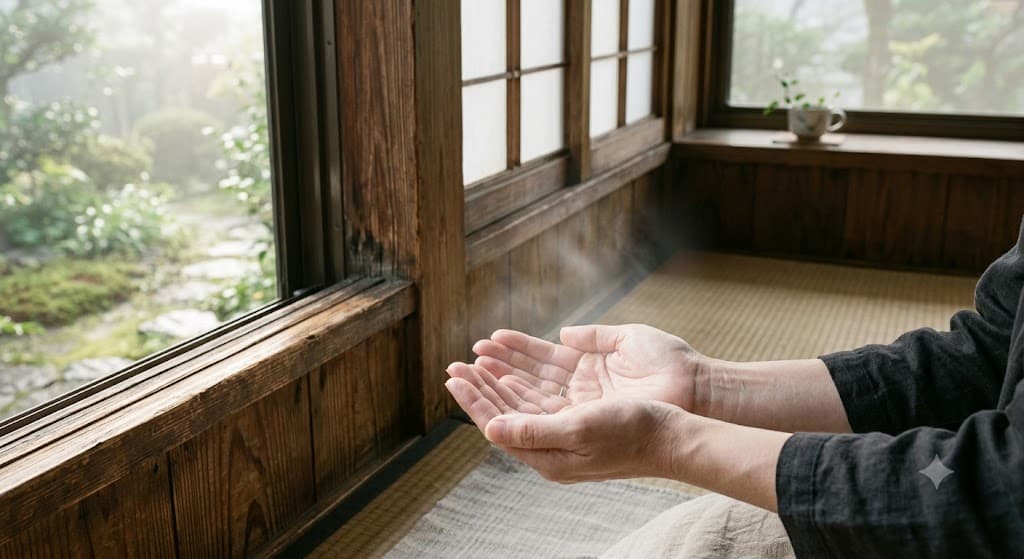
 These days my honest morning practice is about five minutes, arms open toward the window.
I also want to be straightforward about the evidence. There is no accepted scientific proof of the energy field that Reiki describes, and no clear evidence that it helps any specific health condition. It has also shown no known harm. So I never speak of curing or treating anything. What I can say, from my own life and my students', is that it helps things feel lighter and more settled. A common misunderstanding is that the harder you concentrate or the longer you sit, the more it works. In my experience it is the opposite: relaxation matters most, and even a short session is enough. My own honest five minutes each morning, arms opened toward the window, are the proof I trust.
One last honesty: the neat "Japanese versus Western" line is blurrier than the marketing suggests. Many teachers who advertise a "Japanese style" actually carry a Western lineage and attunement. In my own experience the practice itself does not feel weaker or stronger for the label on the flyer; what changes is the emphasis and the manner. So do not choose by the label. Choose by the teacher, the emphasis, and whether it fits your life right now.
FAQ
Q: Is Japanese Reiki better than Western Reiki?
A: Neither is stronger. They draw from the same source and differ mainly in emphasis — repeated reiju and intuition on one side, structured attunements and fixed hand positions on the other. The better one is the one whose approach and teacher suit you.
Q: Do I need to learn Japanese to practise traditional Reiki?
A: No. The Japanese terms help you understand the tradition and its precepts, but the practice itself is felt with the body, not spoken. After many years I feel the energy with my body rather than through words.
Q: I already learned Western Reiki — do I have to start over for the Japanese style?
A: No. You can fold the traditional emphases — the Five Precepts, intuitive hand guidance, repeated reiju — into what you already have. It is more a shift of emphasis than a restart.
Key Insights to Remember
- The precepts are the quiet centre of the whole tradition. If you only take one thing from the Japanese branch, let it be the daily habit of the Five Precepts, because that is where Reiki stops being a technique and starts being a way of living.
- The differences are emphasis, not magic. Reiju and attunement, intuition and fixed positions, are two honest routes to the same practice — and being clear that there is no proven medical effect, only a felt sense of settling, is part of respecting it.
- There is a right time for everything. If Reiki does not interest you right now, it simply is not your moment yet, and no label or lineage should be used to pressure you. When your time comes, you will often find you have started before you even decided to.
Sources
About the author
Japanese Reiki Shihan · traditional Usui Reiki, taught and certified in person
- ●Japanese Reiki Shihan (師範 / Reiki Master)
- ●Trained in the traditional Japanese Usui lineage
- ●20+ years of daily practice · teaches in person
- ●Former IT engineer & founder — grounded, no hype
I'm a Japanese Reiki Shihan who learned in the traditional Usui lineage and has practised every morning for over twenty years. My background is in IT and business, not the spiritual scene, so I write about Reiki plainly — what it is, how to practise it, and what it's honestly like — with no medical claims. Based in the Philippines, where I teach in person.
Enjoy this article?
Get honest, grounded writing on traditional Japanese Usui Reiki straight to your inbox.
Related Articles
Byosen: Sensing With the Hands, and Its Limits
What byosen and hibiki mean in traditional Japanese Reiki, why feeling nothing is normal, and the one boundary I teach.
8/10/2026
Why I Became a Reiki Master
A Shihan on why he trained to teach, and the part he did not expect: beginners' questions exposed how much was habit.
8/2/2026

How a Successful Businessman First Introduced Me to Reiki
I did not come to Reiki through the spiritual world. How a credible businessman changed what I thought it was.
8/1/2026
Reiki Symbols: Why They Were Meant to Be Secret
What the secrecy was actually protecting, and why finding the symbols online changes far less than people assume.
7/29/2026
What Usui Shiki Ryoho Really Means
Usui Shiki Ryoho simply means the Usui-style method — a Japanese Reiki Shihan reads the name of traditional Reiki plainly, without hype or mysticism.
7/4/2026
Reiki's Round Trip: Leaving Japan and Coming Back
Reiki began in Japan, crossed to the West with Hawayo Takata, and returned home reshaped — a practice of connecting with energy that no one culture owns.
7/3/2026