What Usui Shiki Ryoho Really Means
Usui Shiki Ryoho simply means the Usui-style method — a Japanese Reiki Shihan reads the name of traditional Reiki plainly, without hype or mysticism.

Japanese Reiki Shihan (師範) · traditional Usui Reiki · 20+ years of daily practice
Key Takeaways
| Point | In short |
|---|---|
| Plain meaning | "The method in the style of Usui," named after founder Mikao Usui — no religion, no occult. |
| Two names | Common in the Western Takata lineage; Japan's original body used Usui Reiki Ryoho. |
| A method, not a miracle | The name describes settling mind and body through universal energy — it promises a method only. |
- Usui Shiki Ryoho is simply Japanese for "the method in the style of Usui," named after the founder Mikao Usui, and nothing in the name implies religion or the occult.
- The term is most often used in the Western lineage that came through Hawayo Takata, while the original Japanese organisation used the name Usui Reiki Ryoho.
- The name describes a practice for settling the mind and body through connection with universal energy — it promises a method, not a miracle.
Key Terms Explained
| Term | Reading / Meaning | Note |
|---|---|---|
| 臼井式療法 | Usui Shiki Ryōhō / The Usui-Style Method | The full name often used in Western lineages. |
| 靈氣 | Reiki / Universal Energy | The energy of the universe, and the practice of connecting with it. |
| 療法 | Ryōhō / Method of Care | A Taisho-era word, broader and gentler than "therapy." |
| 式 | Shiki / Style | "In the style of," as used for calligraphy or martial arts. |
| 靈授 | Reiju / Attunement | The in-person transmission that opens a student's connection. |
- 臼井式療法 (Usui Shiki Ryōhō) / The Usui-Style Method — the full name often used in Western lineages for the practice founded by Mikao Usui.
- 靈氣 (Reiki) / Universal Energy — the energy of the universe, and the practice of connecting with it.
- 療法 (Ryōhō) / Method of Care — a Taisho-era word for a hands-on well-being method; broader and gentler than the modern English word "therapy."
- 式 (Shiki) / Style — "in the style of," the same word used for schools of calligraphy or martial arts.
- 靈授 (Reiju) / Attunement — the in-person transmission through which a teacher opens a student's connection to the energy.
The Businessman Who First Said the Words to Me
| Takeaway | Detail |
|---|---|
| First impression | Reiki reached me through a grounded businessman, not a "spiritual" figure. |
| Honest start | After my first reiju, I felt little for two weeks — and the name promises nothing more. |
The first time I heard the name of this practice, it did not come from anyone "spiritual." The person who introduced me to Reiki was already successful in business — someone getting real results in the real world, with no incense, no crystals, and no interest in the occult. That first impression shaped everything: before I ever learned what the words meant, I knew the practice belonged to ordinary, grounded life.
 My first impression of Reiki had nothing to do with the mystical image most people expect — it belonged to ordinary, grounded life.
That mattered again after my first attunement, the Level 1 reiju. I kept the simple daily routine — about twenty minutes, every day for two weeks without missing once — and honestly, I did not feel much at first. No instant heat, no tingling, none of the drama some introductions promise. I say this plainly because the name Usui Shiki Ryoho itself makes no such promises either. It only says: here is a method, in the style of one man. Whether you keep practising is up to you.
Related: Who Was Mikao Usui? Separating Reiki's Founder From the Legends explains this in detail.
The Four Words, One at a Time
| Word | Meaning |
|---|---|
| Usui (臼井) | The founder's family name — nothing hidden. |
| Shiki (式) | "In the style of" — one style, not the only way. |
| Ryoho (療法) | A method of care in the Taisho-era sense, not modern clinical therapy. |
| Naming split | Usui Shiki Ryoho (West) and Usui Reiki Ryoho (Japan) are branches of one tree. |
Names in Japanese tend to be descriptive rather than poetic, and this one is no exception. Read piece by piece, it is almost disappointingly practical — which is exactly why I trust it.
 Read one word at a time, the name Usui Shiki Ryoho is almost disappointingly practical — which is exactly why I trust it.
Related: Reiki's Round Trip: How a Japanese Practice Left Home and Came Back Through the West explains this in detail.
Usui (臼井): a family name, nothing more
Usui is simply the surname of Mikao Usui, the founder, who began teaching the practice in Tokyo in 1922 and established the Usui Reiki Ryoho Gakkai (臼井靈氣療法学会), the Usui Reiki Method Society. Naming a method after its founder is the most ordinary thing in Japanese culture — schools of tea ceremony, calligraphy, and martial arts all do the same. There is no hidden meaning in the word; it is a man's name.
Shiki (式): "in the style of"
Shiki means style, form, or way. It is the same character you find in the names of martial arts styles. Its presence in the name quietly acknowledges something honest: this is one style of working with energy, the one Usui shaped. It does not claim to be the only way, and traditional teachers do not claim that either.
Related: Lili Reinhart, Reiki Master: A Careful Reading explains this in detail.
Ryoho (療法): the word that needs the most honesty
Ryoho is usually translated as "healing method" or "therapy," and this is where a careful teacher must slow down. In Taisho-era Japan, when Usui was teaching, hands-on well-being practices of many kinds were common and the word ryoho covered them broadly. It did not carry the strict clinical weight the English word "therapy" carries today.
So let me be direct: Reiki is not medical care. It does not diagnose anything, and I never speak of it as treatment for illness. What the practice offers, in my experience of more than twenty years, is that people feel settled, lighter, and relaxed. That is what ryoho means in my hands — a method of care for the state of your mind and body, practised alongside, never instead of, whatever medical care a person needs.
One name in the West, another in Japan
Here is a detail that surprises many students. The phrase Usui Shiki Ryoho is most strongly associated with the Western lineage — the line that passed from Usui to Chujiro Hayashi, and then to Hawayo Takata, who carried the practice to Hawaii and taught it across the West. In Japan, the original organisation's name was Usui Reiki Ryoho (臼井靈氣療法), with the word Reiki inside it. The two names describe branches of the same tree. Neither is "fake"; they are simply different rooms of the same house, and knowing which room you are standing in is part of practising honestly.
A Name Is a Specification, Not a Promise
| Lens | Reflection |
|---|---|
| Engineer's view | A good name is a specification: founder, style, method — no cosmic claims. |
| How it behaves | Relaxation matters more than effort; five short minutes carry further than strained hours. |
| No pressure | If the name stirs nothing in you yet, that is fine — there is a right time to begin. |
I spent decades as an engineer before I ever taught Reiki, and I still read the world that way. To an engineer, a good name is a specification: it tells you what something is and, just as importantly, what it is not. Usui Shiki Ryoho passes that test. Founder, style, method. No adjectives, no guarantees, no cosmic claims.
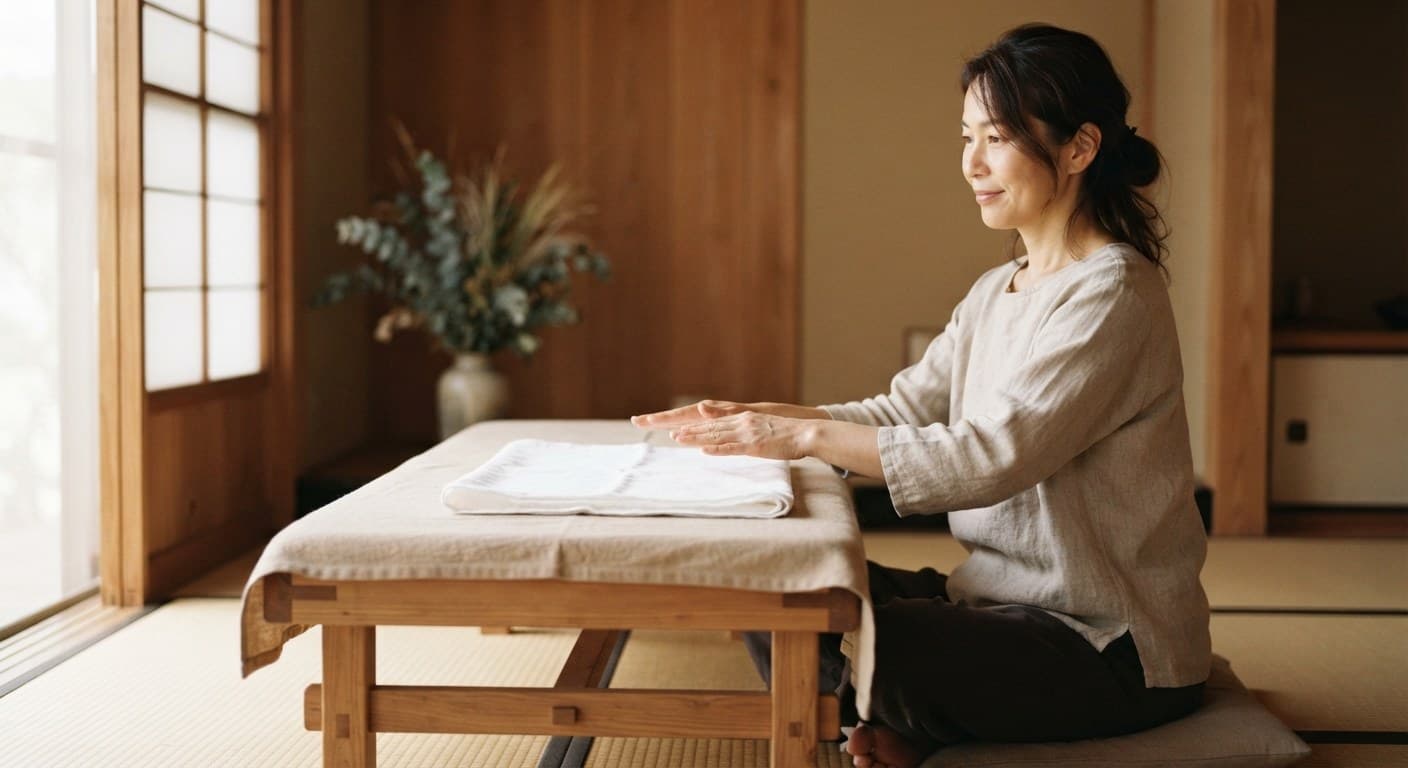
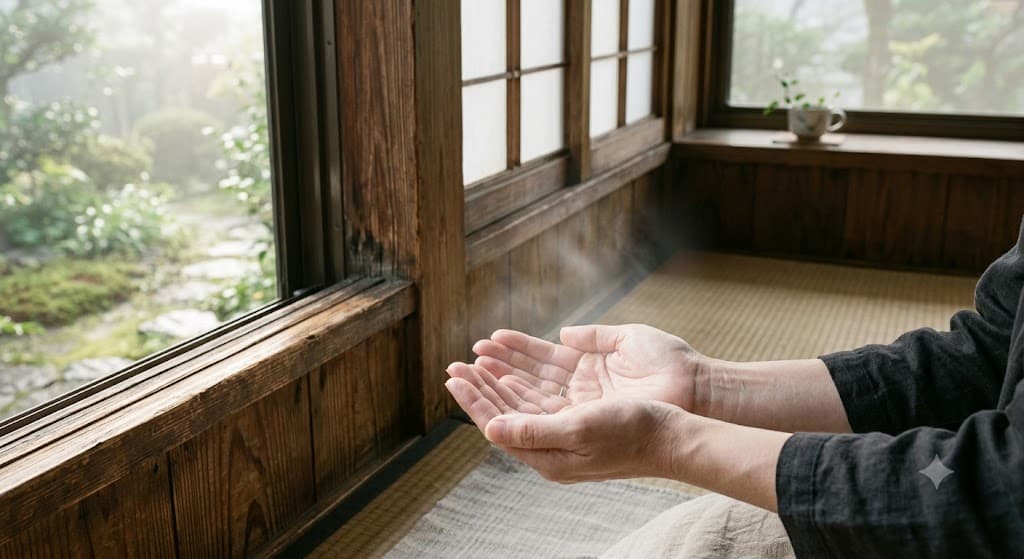
 My whole morning practice takes about five minutes: I open my arms toward the window and let the energy in.
That plainness matches how the practice actually behaves. A common misunderstanding is that the harder you concentrate, or the longer you sit, the more the method "works." My experience is the opposite — relaxation matters most, and even a short session is enough. These days my whole morning practice takes about five minutes: I open my arms wide toward the window, let the energy in, and take it into my body. After all these years I feel it with my body rather than through recited words, and that quiet shift is one honest sign of how far a simple method can carry you.
What turned my early half-belief into conviction was not a mystical event. It was watching my life slowly turn for the better over years of ordinary practice. If you read the name Usui Shiki Ryoho and feel nothing stir, that is fine too. There is a right time to learn anything, and if this is not yours yet, no name — however well chosen — should pressure you into it.
FAQ
Q: Is Usui Shiki Ryoho a religion?
A: No. The name means "the Usui-style method," and the practice involves no worship, no deity, and no required beliefs. It is a way of connecting with universal energy to help life settle, and people of any faith or none practise it.
Q: Does "Ryoho" mean Reiki is a medical treatment?
A: No. Ryoho was a broad Taisho-era word for hands-on well-being methods. Reiki does not diagnose or treat illness; practitioners speak of feeling relaxed, settled, and lighter, and the practice sits alongside, never in place of, professional medical care.
Q: Is Usui Shiki Ryoho different from Usui Reiki Ryoho?
A: They are closely related names for branches of the same tradition. Usui Reiki Ryoho was the name used by the original Japanese organisation, while Usui Shiki Ryoho is the phrase most associated with the Western lineage that came through Hawayo Takata.
Key Insights to Remember
- The honesty of the tradition is built into its name. Usui Shiki Ryoho claims only to be a method in one founder's style, and a practice that begins with such a modest name has no need for hype. When a teacher adds grand promises on top, the addition is theirs, not the tradition's.
- Understanding the word Ryoho in its historical context protects both the practice and the practitioner. It lets us respect what the name meant in 1920s Japan while being completely clear today: this is a relaxation and well-being practice, not medicine, and the two should never be confused.
- A plain name suits a plain practice. Five honest minutes each morning, done in a relaxed state, carries further than an hour of strained effort — and nothing in the name Usui Shiki Ryoho suggests otherwise. The method asks for consistency, not intensity, and it leaves the timing of your first step entirely to you.
Sources & References
About the author
Japanese Reiki Shihan · traditional Usui Reiki, taught and certified in person
- ●Japanese Reiki Shihan (師範 / Reiki Master)
- ●Trained in the traditional Japanese Usui lineage
- ●20+ years of daily practice · teaches in person
- ●Former IT engineer & founder — grounded, no hype
I'm a Japanese Reiki Shihan who learned in the traditional Usui lineage and has practised every morning for over twenty years. My background is in IT and business, not the spiritual scene, so I write about Reiki plainly — what it is, how to practise it, and what it's honestly like — with no medical claims. Based in the Philippines, where I teach in person.
Enjoy this article?
Get honest, grounded writing on traditional Japanese Usui Reiki straight to your inbox.
Related Articles
Byosen: Sensing With the Hands, and Its Limits
What byosen and hibiki mean in traditional Japanese Reiki, why feeling nothing is normal, and the one boundary I teach.
8/10/2026
Why I Became a Reiki Master
A Shihan on why he trained to teach, and the part he did not expect: beginners' questions exposed how much was habit.
8/2/2026

How a Successful Businessman First Introduced Me to Reiki
I did not come to Reiki through the spiritual world. How a credible businessman changed what I thought it was.
8/1/2026
Reiki Symbols: Why They Were Meant to Be Secret
What the secrecy was actually protecting, and why finding the symbols online changes far less than people assume.
7/29/2026
Reiki's Round Trip: Leaving Japan and Coming Back
Reiki began in Japan, crossed to the West with Hawayo Takata, and returned home reshaped — a practice of connecting with energy that no one culture owns.
7/3/2026
Japanese vs Western Reiki: 7 Differences That Matter
Traditional Japanese and Western Reiki share one founder but differ in reiju, the Five Precepts, and intuition over fixed hand positions — not in raw power.
7/1/2026